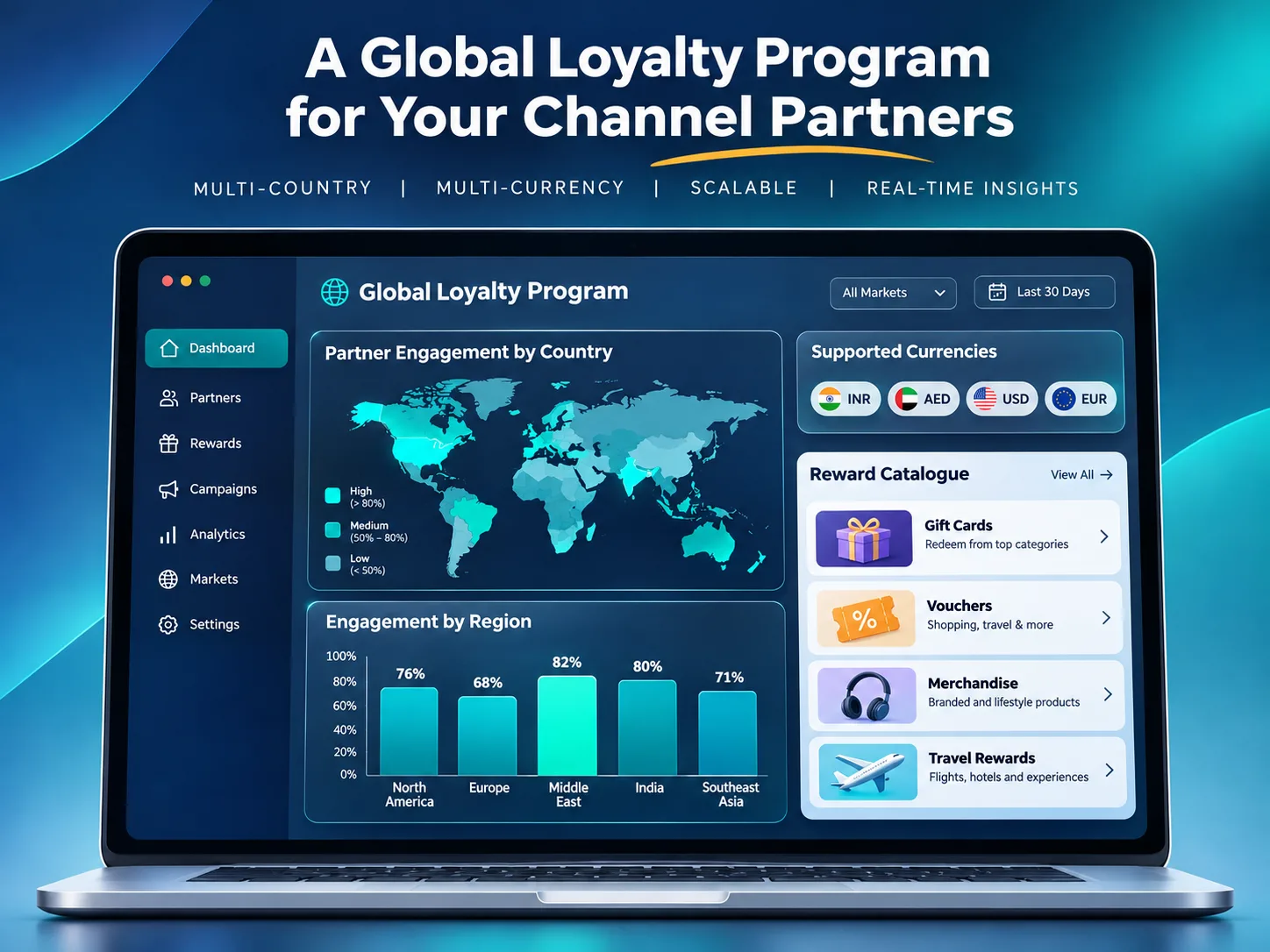
Global brands rarely grow through head office alone any more. Growth comes from the dealers, distributors, installers and resellers who carry your products into each market. That shift raises an awkward question for channel and marketing leaders: if your partners now work across borders, why is your loyalty program still split country by country?
This article walks through why fragmented regional programs hold brands back, what makes multi-country programs hard, and a practical framework for running one partner loyalty program across many markets. It draws on the full guide published by Loyltworks, Multi-Country Loyalty Programs: The Complete Global Strategy.
The hidden cost of country-by-country programs
For years the default was simple: each region picked its own vendor, built its own reward catalogue and reported results its own way. It looked flexible. In practice it produced several vendors doing the same job, duplicated budgets, reward structures that did not match from one market to the next, and reports that could not be compared.
Partners notice the gaps. A distributor working in both the Middle East and Africa sees two different programs from the same brand. A reseller in India serving clients across Asia hears what partners elsewhere are earning. When rewards feel inconsistent, motivation drops and competitors with a cleaner offer gain ground.
Leadership feels it too. Without one view of the data, it is hard to answer basic questions: which markets are growing, which campaigns actually moved sales, and which partners deserve more investment.
Who a global program needs to reward
A multi-country program is rarely one audience. Most brands run several partner tracks under one roof:
- Trade and retail. Distributors, dealers and stores, usually through a Retailer Loyalty Program and a wider Channel Incentive Program.
- Influencers on site. Paint brands run a Painter Loyalty Program, auto-parts brands a Mechanic Loyalty Program, and building-material brands a Contractor Loyalty Program.
- Specifiers. An Architect Loyalty Program or an Interior Designer Loyalty Program rewards the people who recommend a brand before the order is placed.
- Your own people and end buyers. A Sales Incentive Program keeps field teams aligned, and a Customer Loyalty Program rewards repeat buyers.
What makes global loyalty difficult
A multi-country program has to balance global consistency with local relevance. Four areas cause most of the trouble.
- Compliance and tax. Rewards are taxed differently by country, some regions restrict incentives, and data laws such as GDPR and PDPA shape what you can collect. Compliance is the foundation, not an afterthought.
- Reward preferences. Gift cards tend to work well in North America and Europe, prepaid cards in the Middle East, electronics and merchandise in much of Asia, and cash-equivalent rewards in many emerging markets.
- Currency and fulfilment. Shipping, customs, currency conversion and vendor coordination slow everything down when handled manually.
- Culture. Competitive markets respond to leaderboards and rankings. Relationship-driven markets respond to recognition, status and community.
A four-step framework
1. Start with business outcomes
Decide what the program must achieve before choosing a single reward: higher distributor sell-out, faster product launches, entry into new markets, better partner retention, or more partners completing training and certification.
2. Set up clear governance
A three-layer model keeps speed and control in balance. The global team owns strategy, budget, technology, reporting and reward partnerships. Regional teams adapt campaigns, handle communication and onboard partners. Local teams validate compliance, adapt language and support execution.
3. Offer choice in rewards
The most reliable global reward strategy is choice. A mix of gift cards, digital vouchers, prepaid cards, merchandise and travel experiences lets partners in each market pick what matters to them, instead of head office guessing.
4. Communicate in the partner's language
Onboarding journeys, campaign announcements, milestone celebrations, redemption reminders and training nudges all perform better when they are localised. A partner-facing Loyalty App in the local language is often the simplest way to do this.
The role of technology
Spreadsheets and email can run a pilot in one country. They cannot run thousands of partners across a dozen currencies. This is where Loyalty Management Software earns its place. A central B2B Rewards Platform should provide:
- Campaign templates that launch globally and adapt locally from one dashboard
- Automated reward fulfilment across many countries, covering vouchers, prepaid cards and merchandise
- A multi-currency wallet and points engine so earning stays fair across regions
- Real-time analytics by country, partner segment, campaign and product
- Compliance and tax workflows that reduce manual paperwork
Choosing the right partner
Not all Loyalty Software is built for channel partners across borders. When comparing Loyalty Software providers, check for multi-currency wallets, global reward fulfilment and local compliance support. Reviewing a list of Top Loyalty Program Companies helps, but the best fit is usually a Loyalty Management Company that offers both B2B Rewards Software and hands-on program design.
What results look like
Brands that move from fragmented regional schemes to one global program commonly report 20 to 40 percent higher partner engagement and 15 to 30 percent more repeat purchases, along with faster product adoption and lower partner churn. Savings come from the other side as well: fewer vendors, reusable campaign templates, and reporting that lets leaders move budget to the markets that perform.
Key takeaways
- Fragmented regional programs quietly drain budget and weaken engagement.
- Central governance with local flexibility gives both control and speed.
- Local rewards and compliance decide whether partners trust the program.
- The right platform turns loyalty into a measurable growth engine.
Frequently asked questions
What is a multi-country loyalty program?
It is one partner engagement strategy that rewards dealers, distributors, installers and resellers across several markets, while adapting rewards, language and compliance to each country.
Why move from regional programs to a global one?
A single program cuts duplicate vendor costs, gives partners a consistent experience, and gives leadership one comparable view of performance.
How are different currencies handled?
A multi-currency wallet lets partners earn on a standard structure and redeem in local currency, with conversion handled automatically.
Which industries benefit most?
Any business that sells through channel partners in several countries, including manufacturing, automotive, technology, FMCG and building materials.
To plan a loyalty program for partners in more than one market, read the full multi-country loyalty guide or explore the B2B loyalty platform at Loyltworks.