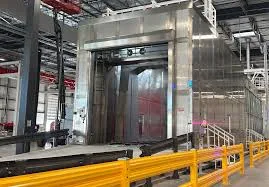
An overhead conveyor carries products along an elevated track, often above the factory floor. Items may hang from hooks, travel on suspended carriers or move through a guided system that connects different stages of production.
When this conveyor passes through a wall or ceiling, it creates an opening that needs special attention. Leaving the opening permanently exposed may allow smoke, heat, dust or conditioned air to move between areas. A conventional door may not work because the conveyor and its loads need to travel through the same space.
An overhead conveyor door is designed around this unusual arrangement. It provides a way to close the opening without unnecessarily disrupting the conveyor route.
The exact design depends on the purpose of the door. Some systems are primarily intended to provide a fire-resistant barrier that closes during an emergency. Others are designed for frequent opening and closing to help control dust, temperature or access during normal production. These are different applications, and a door suitable for one purpose should not automatically be assumed suitable for the other.
How Does an Overhead Conveyor Door Work?
The operating principle depends on the type of closure installed.
In a fire-protection application, the door is generally arranged to remain open during normal conveyor operation and close when the building's fire-safety system sends the appropriate signal. Smoke detectors, heat detectors or another approved release arrangement may trigger the closing sequence, depending on the system design.
The door then moves into its closed position across the opening. Some designs use a sliding panel, while others use lifting, lowering or hinged sections. The conveyor route and its supporting structure must be considered when planning this movement.
A different arrangement may be used when the door operates as part of an everyday production process. For example, a small rapid-roll door may open when a product approaches a transfer point and close after the item has passed through. Sensors and conveyor controls can coordinate these movements.
Think of the difference between a fire shutter and an automatic entrance at a busy warehouse. Both open and close, but they have different jobs, operating requirements and safety expectations.
Fire Protection in Conveyor Openings
One important application for conveyor system doors is maintaining fire separation between different parts of a building.
Factories and distribution centres often contain large conveyor networks that cross walls, floors or ceilings. These openings can create routes through which fire and smoke may spread if they are not properly protected.
A specially designed conveyor closure helps address this problem. During normal operation, the conveyor can transport products through the designated opening. When the required fire signal occurs, the closure moves into position to help restore the building's fire barrier.
The system must be designed for the particular opening and conveyor arrangement. A standard fire door cannot simply be fitted around a moving conveyor without considering the space occupied by the track, carriers and transported goods.
The required fire performance also depends on the building's fire strategy, applicable regulations and the tested or approved door configuration. A product's fire rating should never be assumed to apply to every possible installation.
Different Types of Overhead Conveyor Doors
There is no universal door arrangement for every conveyor layout. The best configuration depends on the available space, the direction of movement, the conveyor's height and the type of protection required.
Sliding Conveyor Doors
A sliding conveyor door moves sideways to close the opening. The panel travels along a guide or track, which can be positioned to suit the surrounding structure.
This arrangement may be useful where there is enough room beside the opening for the panel to move. It can also be designed around conveyor equipment that passes through the wall.
Sliding systems are available in different configurations, including single-panel and double-panel arrangements. The choice depends on the width of the opening and the space available for the moving sections.
The supporting track and surrounding structure must be planned carefully. The door should move without colliding with conveyor components, nearby machinery or building services.
Lifting and Lowering Doors
A lifting conveyor door moves vertically to close or clear the opening. Depending on the design, the panel may travel upward or downward.
This arrangement can be considered when sideways movement is restricted. It may also suit openings where the conveyor passes through a particular section of the wall and the closure can move clear of the product path.
The door's weight, guiding arrangement and available vertical clearance all influence the design. The movement system must also be reliable enough to complete its intended operation when required.
Hinged Conveyor Doors
A hinged design uses one or more panels that rotate around fixed hinges. It may be suitable for certain conveyor arrangements where the opening and surrounding space allow the panels to swing clear.
Single-leaf and double-leaf configurations are possible. The number and size of panels depend on the opening dimensions and the required movement.
Hinged designs need careful attention to the conveyor's path. The door must not obstruct suspended loads, carriers or other moving parts when opening or closing.
High-Speed Conveyor Hatch Doors
Some facilities need a door that opens and closes repeatedly during normal production. In these applications, a high-speed conveyor door or compact rapid-roll door may be installed at a conveyor opening or transfer hatch.
For example, a production line may move printed materials, packaged goods or components between two rooms. A small powered door can open for each transfer and close after the product passes.
This type of arrangement can help limit the time an opening remains exposed. Depending on the application, it may support temperature management, dust control or separation between work areas.
It is important to distinguish these process doors from fire-rated conveyor closures. A rapid-roll door is not automatically a fire door, and a fire-rated closure is not necessarily designed for frequent production cycling.
Coordinating the Door with Conveyor Movement
One of the most important parts of an overhead conveyor door installation is ensuring that the door and conveyor work together.
The conveyor may carry products continuously or move items in controlled batches. Some systems use suspended hooks, while others transport larger carriers or components. The closure must accommodate the actual movement pattern.
For an automatically operated process door, sensors can identify when a product approaches the opening. The control system can then request that the door opens at the correct moment. Once the product has passed, the door can close again.
The timing needs to be carefully planned. If the door closes too early, it could interfere with the load. If it remains open longer than necessary, the separation between the two areas may be reduced.
For a fire-protection closure, the control arrangement has a different purpose. It must respond to the approved fire signal and complete its closing sequence in accordance with the system's design. Conveyor movement may need to stop or be managed in a defined way so that products do not obstruct the closing area.
The door and conveyor should therefore be treated as connected parts of one installation, with their controls and safety functions properly coordinated.
Keeping Products and People Safe
An overhead conveyor door must be designed around more than the opening itself. It also needs to account for the products travelling through it and the people working nearby.
A suspended load may swing slightly as it moves. A bulky product may extend beyond its carrier. If the opening is too small or poorly positioned, items could strike the door frame or surrounding equipment.
The design team should identify the largest load that will pass through the opening, including any hooks, carriers or attachments. Adequate clearance must be provided according to the conveyor manufacturer's requirements and the installation design.
People also need safe access around the system. A conveyor opening should not become an informal walkway simply because it is large enough for products to pass through. If employees need to cross the conveyor route, a separate access arrangement and suitable safeguards should be planned.
For fire-rated closures, the closing area must remain clear so the door can perform its intended function. Depending on the system, sensors or other devices may monitor the area and help prevent an obstruction from interfering with operation.
Managing Dust, Temperature and Air Movement
Not every conveyor door is installed for fire protection. Some are selected to help maintain different working conditions on either side of an opening.
Consider a factory where one room is kept cooler than another. A conveyor transfers products between the two spaces throughout the day. If the opening stays uncovered, the temperature difference may become harder to maintain.
A suitable industrial conveyor door can close between transfers, reducing the period during which the two environments are directly connected.
Similar considerations apply when a facility needs to limit dust movement. A production area handling powders, packaging materials or fine components may benefit from a controlled opening rather than a permanently exposed passage.
The level of separation depends on the door's construction, perimeter seals, operating speed and the way it is integrated with the conveyor. A door should not be described as airtight or dustproof unless its performance has been established for the particular product and installation.
Materials and Construction Considerations
The construction of an overhead conveyor door should reflect its working environment and intended function.
Fire-protection closures may use specially designed panels and internal materials that help the assembly achieve its tested fire performance. Steel coverings, supporting frames, guides and suitable sealing arrangements may form part of the complete system.
Process doors may use different materials, including flexible curtains or rigid panels. The choice depends on the opening size, operating frequency, cleaning requirements and the type of products moving through the conveyor.
Several practical factors should guide material selection:
- Durability: The door should withstand the expected number of operating cycles and the conditions around the conveyor.
- Corrosion resistance: Moisture, cleaning products and certain production environments may influence the choice of metal and surface finish.
- Sealing: The edges and contact areas should suit the level of separation required.
- Cleaning: Surfaces should be accessible for routine inspection and cleaning where necessary.
- Impact resistance: The design should account for possible contact with carriers or transported products.
- Service access: Motors, guides, controls and other working components should be accessible for maintenance.
The door panel is only one part of the assembly. Frames, tracks, supports, seals and operating equipment all contribute to its performance.
Where Are Overhead Conveyor Doors Used?
These specialised closures can be useful in facilities where conveyor routes cross building divisions or where products move between controlled areas.
Distribution and Logistics Centres
Large distribution buildings often use automated conveyor networks to move parcels, cartons and packaged goods. Conveyor routes may pass through internal partitions or fire-separated areas.
A suitable conveyor fire door can be designed to close the relevant opening during an emergency while allowing normal material movement when the system is operating.
Automotive Manufacturing
Vehicle manufacturing plants use conveyors to transport components, assemblies and vehicle bodies between production stages. Some routes pass through walls or separate manufacturing zones.
Door design must account for the size and shape of the transported items, the conveyor arrangement and the required separation between spaces.
Food and Beverage Production
Food-processing facilities may transfer products between preparation, processing, packaging and storage areas. Depending on the process, doors may help manage temperature differences, dust or hygiene-related separation.
The materials and finishes should be compatible with the facility's cleaning practices and operating conditions.
Pharmaceutical and Packaging Facilities
Automated material-handling systems can move containers, packaging materials and finished products between production rooms. In these environments, a controlled opening may help support the separation of different work areas.
The door specification should be based on the facility's actual cleanliness, temperature and process requirements.
General Manufacturing
Factories producing household goods, printed products, electrical components and industrial equipment may also use overhead conveyor systems. A tailored closure can help manage the openings where these systems pass through walls or other barriers.
Installation Planning: What Should Be Checked?
An overhead conveyor door should be considered early in the building or production-line design process. Retrofitting a closure after the conveyor has been installed may be more complicated because the available space and access routes are already restricted.
Before selecting a system, the project team should review:
Opening dimensions: Measure the full width and height of the required closure area, including the space occupied by the conveyor and its loads.
Conveyor position: Confirm the track height, direction of travel, support points and any movement beyond the main conveyor path.
Product clearance: Check the largest item, carrier or suspended load that must pass through the opening.
Available installation space: Identify whether there is room for a sliding panel, lifting mechanism, hinged leaves or roller assembly.
Building construction: The surrounding wall, floor or ceiling must be suitable for supporting the door and its operating components.
Control requirements: Establish how the closure will communicate with the conveyor, sensors, fire alarm or other building systems.
Inspection and servicing: Make sure technicians can reach the relevant parts without dismantling unrelated equipment.
Where fire protection is required, the complete installation must match the approved or tested configuration and be installed according to the applicable requirements. Changes to the opening, supporting structure or conveyor arrangement may affect the suitability of the tested design.
Maintenance for Dependable Operation
A conveyor door may operate automatically many times during a working day, or it may remain in a standby position until an emergency signal occurs. Either way, it needs an appropriate inspection and maintenance programme.
For frequently operated doors, maintenance may include checking the motor, guides, rollers, hinges, seals and control equipment. The panel should move smoothly and stop at the intended positions.
For fire-protection closures, inspection should confirm that the release mechanism, closing arrangement, monitoring devices and other safety-related components remain functional. The door's path must also be kept free of stored goods, tools and other obstructions.
Maintenance teams should follow the manufacturer's instructions and the building's documented safety procedures. Any damage or operating fault should be investigated promptly rather than ignored until the next scheduled service.
Keeping records of inspections and repairs can help facilities identify recurring problems and plan replacement parts before a failure interrupts production.
Choosing the Right Overhead Conveyor Door
The most suitable solution is the one that matches the conveyor layout and the reason the opening needs to be closed.
A facility requiring fire separation needs a properly tested and approved conveyor closure for its specific application. A production line seeking to reduce dust or temperature exchange may need a fast-operating process door. These systems have different performance requirements, so the intended function should be established before comparing designs.
Useful questions to consider include:
- Does the opening need fire protection, environmental separation or both?
- Does the conveyor operate continuously or in timed batches?
- What are the maximum dimensions of the products and carriers?
- Is there sufficient room for the door to move?
- How will the door respond to a fire signal or conveyor-control command?
- What safety measures are needed to prevent products from obstructing the closure?
- What inspection and maintenance arrangements will be required?
The conveyor supplier, door manufacturer, building designer and fire-safety specialists should work together where their systems interact. This coordination helps avoid conflicts between the door's movement, the conveyor's route and the building's protective requirements.
Conclusion
An overhead conveyor door solves a specialised problem found in modern industrial buildings: how to allow products to move through a wall or ceiling while retaining the ability to close that opening when needed.
Depending on the application, the system may provide fire separation, help manage dust and temperature, or control access between production areas. Sliding, lifting, hinged and rapid-roll arrangements offer different ways to address these needs, but each must be matched to the conveyor's layout and operating conditions.
Good planning is essential. The opening dimensions, product clearance, door movement, control connections and maintenance requirements all influence the final result. When these details are considered together, the closure can support material flow without overlooking the building's safety and operational needs.
Newport Company understands that industrial facilities require door solutions suited to the way their equipment and production processes operate. Selecting the right system for a conveyor opening begins with understanding the application, the surrounding structure and the performance the door is expected to deliver.