
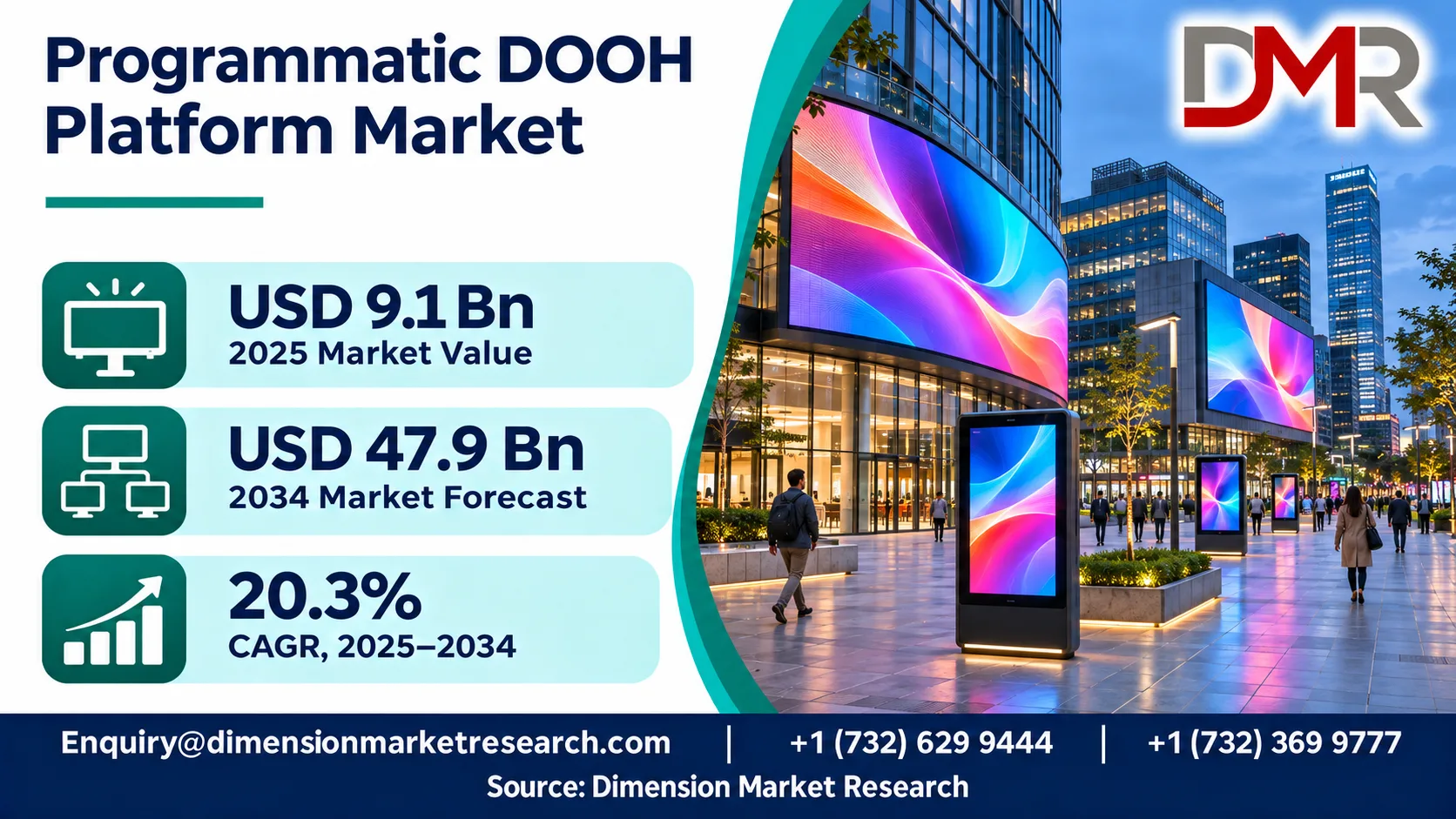
According to Dimension Market Research, the global Programmatic DOOH Platform Market was valued at USD 9.1 billion in 2025 and is projected to reach USD 47.9 billion by 2034, growing at a CAGR of 20.3%. Automated media buying, location-based targeting, and the expansion of connected digital screens are driving demand. For advertisers, the opportunity is to buy outdoor media with more control over where and when a campaign runs. For media owners, it is to make more screen inventory available to buyers without managing every placement manually.
What Is a Programmatic DOOH Platform?
A programmatic digital out-of-home (DOOH) platform automates the buying, selling, and delivery of advertising on digital billboards and screens in places such as transit stations, shopping centers, and airports. The market includes demand-side platforms for media buyers, supply-side platforms for screen owners, ad exchanges, campaign management and measurement software, and supporting services. An advertiser can use these tools to select locations, set delivery windows, and adjust which creative runs based on conditions such as the time of day.
Get a Free Sample of the Programmatic DOOH Platform Market Report
Request a free sample to review how the report groups platform components, deployment models, buying methods, and targeting approaches. Use it to assess the study’s fit for your media buying, product, or partnership plans.
https://dimensionmarketresearch.com/request-sample/programmatic-dooh-platform-market/
Real-Time Bidding Leads, With a Role for Guaranteed Inventory
Real-time bidding (RTB) led by buying model with an estimated 48.0% share in 2025. It gives advertisers flexibility to bid on available inventory based on location, time, and other contextual signals. Programmatic guaranteed serves a different buying need by allowing advertisers to reserve placements in advance. A retailer promoting a short sale can use RTB to adjust delivery across locations, while a brand launching a new product may prefer to reserve screens in prominent locations for a fixed period.
Cloud-based platforms led deployment with an estimated 77.0% share in 2025. Centralized inventory management helps agencies and media owners coordinate campaigns across multiple cities and screen networks. For buyers evaluating platforms, the practical questions include which networks they can access, how quickly they can change a campaign, and whether delivery reports use consistent definitions across locations.
Location-Based Targeting Leads as Buyers Scrutinize Measurement
Location-based targeting held an estimated 46.0% share in 2025, while brand awareness led by campaign objective at approximately 55.0%. A retailer, for example, can choose screens near its stores and schedule ads around periods of higher foot traffic. When the objective is to measure store visits, however, differences in footfall estimates and attribution methods can make it difficult to compare results across networks or isolate the effect of outdoor advertising from other media running at the same time. Defining success before launch helps buyers determine what the available reporting can measure.
Where Are Screen Networks Expanding?
North America led with an estimated 38.0% share in 2025. Asia-Pacific is projected to grow fastest, supported by urban development and investment in connected screens. The report covers companies including Vistar Media, Broadsign, Hivestack, JCDecaux, and Place Exchange. In September 2026, VIOOH partnered with TuMedio to make more than 500 screens in Spain and Portugal available to programmatic buyers. The partnership illustrates how platforms can expand their geographic reach by bringing existing screen networks into automated buying systems.
Frequently Asked Questions
1. How large is the Programmatic DOOH Platform Market?
The global market was valued at USD 9.1 billion in 2025 and is projected to reach USD 47.9 billion by 2034.
2. What is the projected CAGR of the Programmatic DOOH Platform Market?
The market is projected to grow at a CAGR of 20.3% from 2025 to 2034.
3. Which buying model leads the market?
Real-time bidding leads, with an estimated 48.0% share by buying model in 2025.
4. Which targeting approach has the largest market share?
Location-based targeting leads, with an estimated 46.0% share by targeting type in 2025.
5. Which region is projected to grow fastest?
Asia-Pacific is projected to grow fastest, supported by urbanization and investment in connected digital infrastructure.
Conclusion
Programmatic buying is making more digital outdoor inventory accessible through the same tools advertisers use to plan and manage campaigns. Through 2034, connected screens in transit and retail locations offer room for expansion. Platforms that give buyers clear inventory information and consistent reporting can help them evaluate outdoor placements alongside the rest of their media plan.
Related Advertising and Digital Display Market Insights
The Japan Programmatic Advertising Market Size report estimates the market at USD 27.6 billion in 2026 and projects USD 204.0 billion by 2035. Connected TV, retail media, and campaign automation support the outlook.
The Digital Signage Market Share report identifies North America as the leading region, with a 35.0% share in 2023. It provides context on the display infrastructure used for advertising and other screen-based applications.
The AdTech Market Growth report projects a 14.7% CAGR from 2026 to 2035 and covers demand-side platforms, supply-side platforms, ad networks, and data management platforms.