
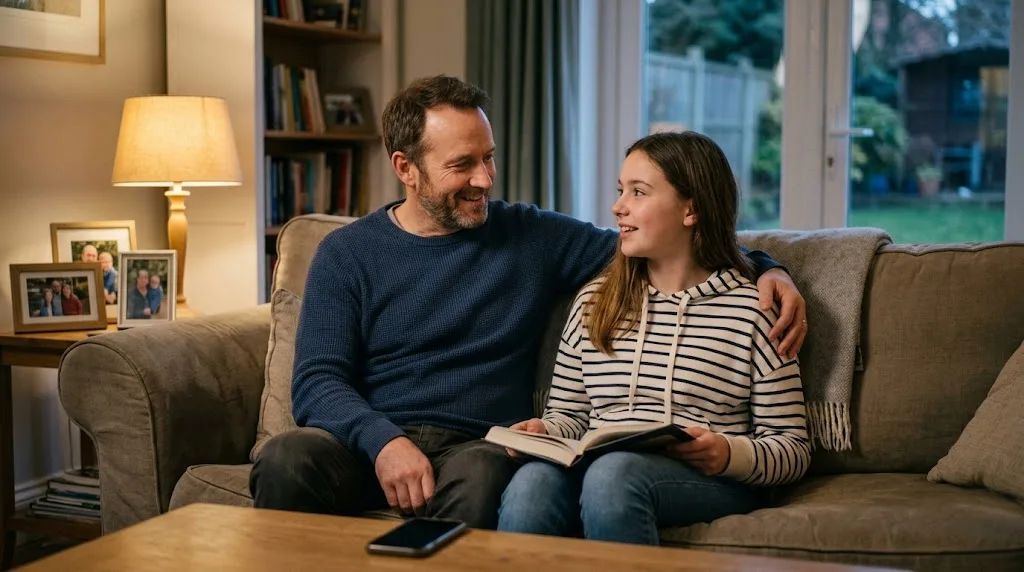
Every generation of parents has faced a version of the same question: how do I keep my child safe once they step outside my direct line of sight? For our parents, that meant knowing which street corner was safe to play on, or what time the streetlights came on. For us, the "street corner" has moved into a screen, and it never really has an edge. Our kids can be sitting three feet away from us on the couch and still be navigating a world we can't see into.
That shift has understandably made a lot of parents anxious. And when parents feel anxious about something they can't observe directly, the instinct is often to look for a way to observe it — a tool, an app, a dashboard that promises visibility. But research on child development and family communication points to something a little less high-tech and a lot more durable: kids who grow up with open conversations about their digital lives, rather than covert monitoring, tend to develop stronger judgment, more resilience against online risks, and more willingness to come to a parent when something actually goes wrong.
The Difference Between Oversight and Surveillance
Oversight is something a child knows about and, ideally, has some say in — shared account logins, a family agreement about screen time, parental controls that are set up together at the kitchen table. Surveillance is something done to a child without their knowledge, and it tends to produce a very different relationship with technology, and with the parent.
Developmental psychologists who study adolescent autonomy have found that teens who discover they've been secretly monitored often respond by getting better at hiding things — not by becoming safer. The monitoring doesn't disappear the risks; it just pushes them further out of view, into private group chats, secondary accounts, or borrowed devices. Meanwhile, the sense of betrayal that comes from discovering covert tracking can damage trust in ways that take years to repair, right at the developmental stage when kids most need to feel they can talk to an adult without it being used against them.
What Actually Works: Built-In, Transparent Tools
The good news is that you don't need anything covert to set meaningful boundaries. Both major mobile operating systems now include robust, built-in family safety features that are visible to everyone in the household:
- Apple's Screen Time lets parents set app limits, content restrictions, and downtime windows, and — critically — the child can see that these settings exist.
- Google's Family Link offers similar functionality for Android devices, including app approval requirements and activity summaries that are part of an open family agreement rather than a hidden log.
- Most home routers and internet providers also offer network-level content filtering that applies to every device in the house, which sidesteps the need to manage each device individually.
These tools work best not as a "set it and forget it" fix, but as the starting point for a conversation: Here's why we're setting this limit. Here's what we're worried about. Here's what you can do if you run into something upsetting online.
Talking to Kids About Online Life, By Age
Early elementary (ages 5–8): Keep it concrete. Kids this age respond well to simple rules — devices stay in shared spaces, and if something online feels confusing or scary, they tell an adult right away, no exceptions and no trouble for asking.
Upper elementary to early middle school (ages 9–12): This is the window to introduce ideas like digital footprints, why personal information (school name, address, daily schedule) shouldn't go to strangers online, and how to recognize when someone is trying to manipulate or pressure them.
Teens (13+): Autonomy needs to expand, but so does nuance. Conversations shift toward critical thinking — how to evaluate whether a source or person online is trustworthy, how algorithms shape what they see, and how to handle peer pressure in group chats or social media. This is also the age where privacy starts to matter developmentally; teens who feel entitled to some privacy at home are, somewhat counterintuitively, more likely to self-regulate responsibly online.
Building a Family Media Agreement
One practical exercise that family therapists frequently recommend is sitting down together — not just announcing rules — to draft a simple, shared media agreement. It might cover:
- Which apps and platforms are okay to use, and at what age
- Device-free times and zones (meals, an hour before bed, etc.)
- What to do if a child sees something upsetting or is contacted by a stranger
- How screen time limits will be enforced, and by what tool
- A judgment-free promise: mistakes online get reported, not punished
Involving kids in writing this agreement — even young ones — makes them active participants in their own safety rather than subjects of it. It also gives parents a natural, non-confrontational way to revisit and adjust the rules as kids get older.
The Long Game
Digital safety isn't a problem you solve once with the right parental app. It's a skill you build in your child over the course of their whole childhood, the same way you'd teach them to cross a street or handle money. The tools matter less than the relationship they sit inside of. A child who trusts that their parent is on their side — even when they've made a mistake online — is far more likely to come forward when something actually goes wrong, which is the single biggest predictor of a safe outcome in any online incident.
The instinct to protect our kids in a world we can't fully see is a good and normal one. The most effective way to act on it isn't to see everything — it's to make sure your kids know they can always tell you what you can't see.