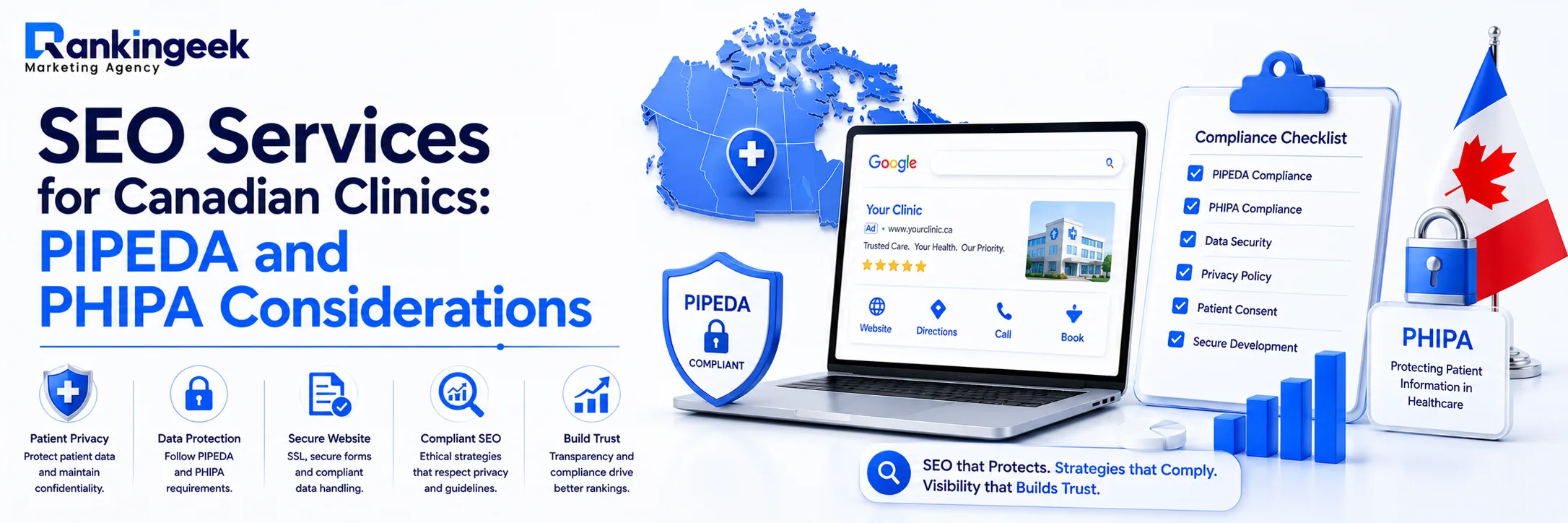
Most conversations about SEO for clinics focus on rankings and reviews. In Canada, there is a quieter question underneath all of it: what happens to the personal information your marketing collects along the way? Every form fill, every tracking pixel, every review reply involves data — and when the business is a clinic, some of that data is health information, the most sensitive category there is.
This guide walks through where SEO and privacy law intersect, in plain language, so you can grow your practice confidently instead of cautiously.
PIPEDA and PHIPA in 60 Seconds
PIPEDA — the Personal Information Protection and Electronic Documents Act — is Canada's federal private-sector privacy law. It requires organizations to obtain meaningful consent before collecting, using, or disclosing personal information, to collect only what they need, and to protect it appropriately. The Office of the Privacy Commissioner of Canada explains the law and businesses' obligations at priv.gc.ca.
PHIPA — Ontario's Personal Health Information Protection Act — governs how "health information custodians" (clinics, practitioners, hospitals) collect, use, and disclose personal health information. Ontario's Information and Privacy Commissioner provides guidance for health organizations at ipc.on.ca. Other provinces have close cousins: Alberta's HIA, and health information acts in BC, Manitoba, and elsewhere.
The practical takeaway: if your clinic markets itself online in Canada, at least one of these frameworks applies to you — and often both.
Where SEO Actually Touches Patient Data
SEO sounds like it is all about Google. In reality, five everyday marketing activities collect personal information:
1. Website analytics and tracking pixels
Analytics tools, heatmaps, and ad pixels can capture IP addresses, device identifiers, and browsing behaviour. On a clinic website, the pages a visitor views can imply health conditions — someone reading your "anxiety counselling" page three times is telling you something sensitive. Compliant setups use consent banners, IP anonymization where available, and strictly avoid sending page-level health context into advertising platforms.
2. Contact and booking forms
The moment a form asks "reason for visit," you are collecting health information through your website. Forms must be transmitted securely (HTTPS), stored in systems with appropriate safeguards, and limited to what you genuinely need to book the appointment. This matters even more when automation is involved — which is why Rankingeek builds its Booking Bot System inside a CRM the clinic itself owns and controls, rather than scattering patient details across third-party tools.
3. Online reviews and replies
Reviews are rocket fuel for local SEO — and a privacy minefield. Even confirming that a reviewer is your patient can be a disclosure of personal health information. The compliant pattern: thank the reviewer generically, never reference their visit or condition, and take any dispute offline. Automated, compliance-checked review workflows, like those in Rankingeek's Reputation Management service, exist precisely so a busy front desk never improvises a reply that crosses the line.
4. Remarketing and lookalike audiences
Uploading patient email lists to ad platforms, or retargeting visitors of condition-specific pages, uses personal (and potentially health) information for advertising. Under Canadian privacy principles this demands explicit, meaningful consent — and in most clinic scenarios the safer answer is simply: don't. Interest-based and geographic targeting can fill the funnel without touching patient data.
5. Testimonials and before/after content
Publishing a patient's story, photo, or outcome requires informed, written, revocable consent — and provincial colleges layer their own advertising rules on top. When in doubt, anonymize or leave it out.
A Compliant SEO Checklist for Canadian Clinics
- Publish a clear, readable privacy policy that names what you collect on the website and why.
- Use a consent banner for analytics and ad cookies; load tracking only after consent.
- Keep intake forms minimal, encrypted, and stored in access-controlled systems.
- Sign agreements with marketing vendors that define how they handle any personal information.
- Never target ads using patient lists or health-condition page visits.
- Train front-desk staff on review replies; use pre-approved templates.
- Prefer content-and-authority SEO (helpful pages, schema, local citations) — it builds rankings with zero patient data.
Notice the pattern in that last point: the strongest SEO levers — great content, technical health, Google Business Profile optimization, earned authority — do not require patient data at all. Privacy-safe and high-performance are the same strategy. That is the philosophy behind Rankingeek's Local Search Domination service and its combined SEO, AEO, and GEO services for Canadian clinics.
What Compliant Healthcare SEO Costs in Canada
Working with a healthcare-only agency does not have to cost more than hiring a generalist — it mostly costs less than cleaning up after one. Rankingeek publishes every plan on its pricing page:
PlanPrice (USD)IncludedLocal Search Domination$1,000 / moLocal SEO, GBP optimization, technical fixes, schema/FAQ structuring for AI search, monthly contentReputation Management$400 / moAutomated, compliance-checked review generation and monitoringGrowth Tier (full engine)$2,750 / moSEO + paid acquisition + booking automation + reputation + social contentDominance Tier$4,500 / moMulti-channel, dedicated account manager, weekly executive reviewEverything is month-to-month after a 90-day pilot, and the clinic owns every asset — website, CRM data, ad accounts, and review platform access. If you ever leave, the engine leaves with you.
Proof It Works in the Canadian Market
Compliance and growth are not opposites. One Canadian mental health clinic working with Rankingeek increased qualified conversions by more than 1,500% — you can read the numbers in the mental health clinic case study — and did it with privacy-safe acquisition rather than aggressive retargeting.
FAQs: PIPEDA, PHIPA, and Clinic Marketing in Canada
1. Does PIPEDA apply to my clinic's website and SEO?
Yes. Analytics, forms, and cookies on your website collect personal information, which brings PIPEDA's consent, limitation, and safeguard requirements into play for commercial activity across Canada.
2. What is the difference between PIPEDA and PHIPA?
PIPEDA is Canada's federal privacy law for commercial activity; PHIPA is Ontario's law specifically governing personal health information held by clinics and practitioners. Many Ontario clinics must consider both.
3. Can Canadian clinics reply to Google reviews?
Yes — but never confirm someone is a patient or mention their visit or condition. Use generic, pre-approved responses and move disputes to a private channel.
4. Is retargeting legal for medical clinics in Canada?
Retargeting based on health-related page visits or patient lists is high-risk and generally requires explicit consent. Most privacy-conscious clinics avoid it and use geographic and interest targeting instead.
5. Does privacy compliance make SEO less effective?
No. The highest-impact SEO tactics — content, technical optimization, Google Business Profile, reviews, and authority building — need no patient data and perform better long-term.
Grow Your Clinic Without Gambling With Patient Trust
You spent years earning your patients' trust. Your marketing should protect it, not spend it. Rankingeek is a healthcare-only agency that builds privacy-safe patient acquisition systems for Canadian clinics — SEO, AEO, and GEO designed to win rankings and AI citations without ever putting personal health information at risk.