What is a single girder EOT crane?
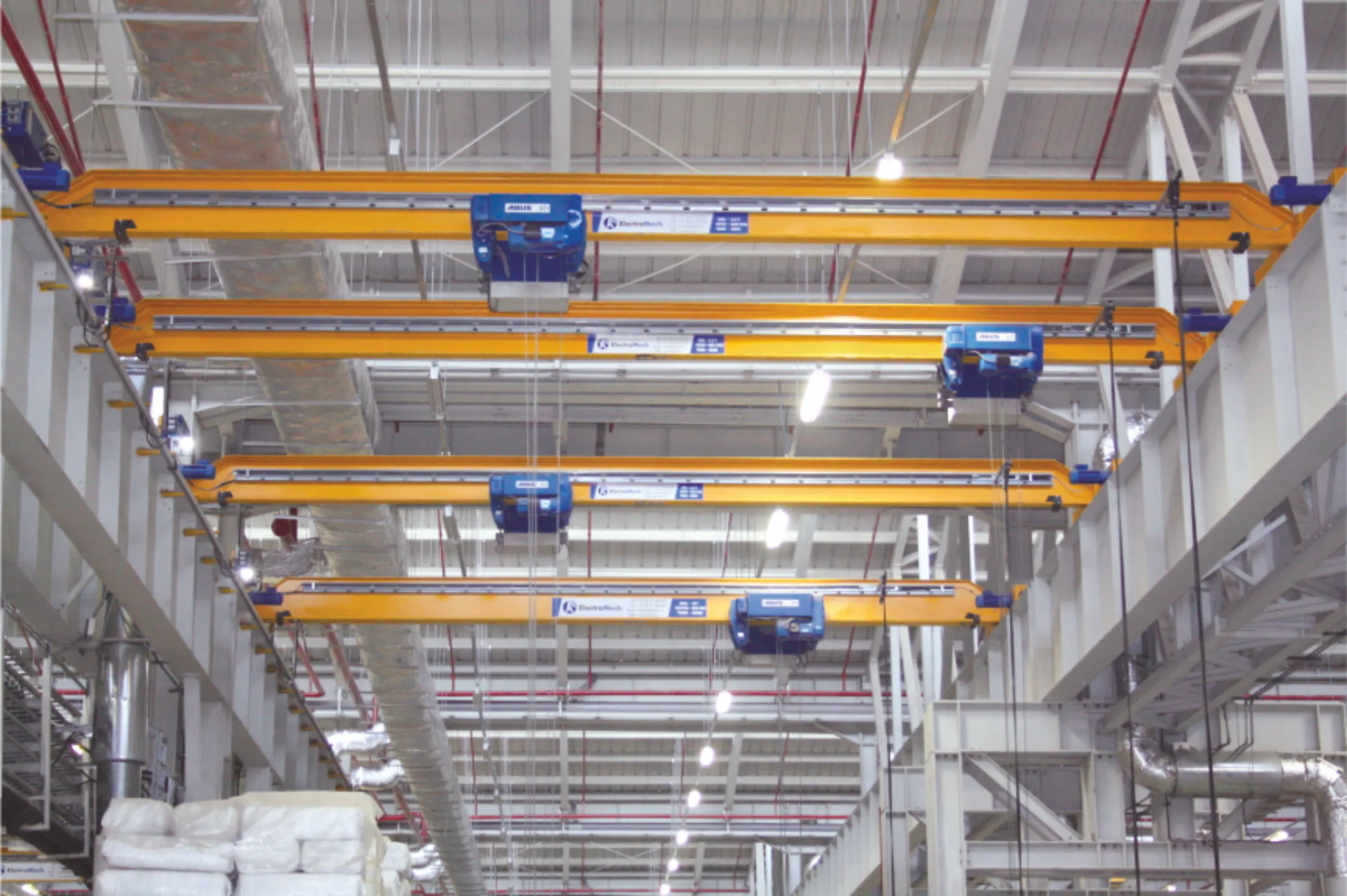
A single girder EOT crane is an overhead crane that has one main beam, called a girder, running across your shop floor. A hoist hangs from this beam and lifts the load. The whole crane then rolls along rails fixed high up on the building walls, so it can reach almost every corner of the floor.
EOT stands for Electric Overhead Travelling. In simple words, it is a crane that runs on electricity and moves along the roof area, so it does not take up any floor space.
Because it has just one beam, it is lighter and simpler than a double girder crane. That is why it is the usual pick for light to medium lifting in factories, workshops and warehouses. ElectroMech's single girder EOT cranes lift from 0.5 tonnes up to 20 tonnes.
How does a single girder EOT crane work?
The crane does its job with three simple movements. The operator controls all of them from a pendant (a hand-held button box hanging from the crane) or a radio remote.
• Lifting: the hoist raises and lowers the load. ElectroMech's hoist speed ranges from 1 to 10 metres per minute.
• Cross travel: the hoist trolley moves left and right along the girder. Speed ranges from 5 to 50 metres per minute.
• Long travel: the whole crane moves forward and backward along the runway rails. Speed also ranges from 5 to 50 metres per minute.
Put these three together and you can pick a load from one spot and set it down almost anywhere in the bay.
Main parts of the crane
• Girder: the single main beam that carries the hoist and spans the width of the shop.
• End carriages: the wheel units at both ends of the girder. They sit on the runway and move the crane along the building.
• Runway beams and rails: the long tracks fixed along both side walls. The crane rides on these.
• Hoist and trolley: the lifting unit with the rope and hook. It travels along the girder.
• Motors and drives: these power each movement. A variable frequency drive (VFD) keeps starts and stops smooth, so the load does not jerk or swing as much.
• Power supply: electricity reaches the moving crane through a shrouded down shop lead (DSL), a covered conductor system running along the runway.
• Controls: a pendant or a radio remote control.
Where are single girder EOT cranes used?
They fit almost any place that needs to move loads inside a shed or workshop. ElectroMech supplies them to many industries, including:
• Steel and metal plants
• Heavy engineering and process equipment
• Pumps and motors
• Construction equipment and precast yards
• Warehousing, paper and packaging
• Power plants (thermal, hydro, wind and waste to energy)
• Railways, metros, ports and shipbuilding
• Aerospace, defence, mining, oil and gas
They can be used indoors and outdoors, and they work in temperatures up to 50 °C.
What are the benefits of a single girder EOT crane?
• Lower cost: one girder means less steel and a simpler build, so the crane is usually cheaper to buy and install than a double girder one.
• Lighter on your building: a lighter crane puts less load on the columns and runway, which helps in both new and existing buildings.
• Compact design: it saves space and lets you use more of your shed's work area.
• Easy upkeep: major parts are easy to reach for servicing, and the sealed bearings are lubricated for life, so they need no regular greasing.
• Safe, smooth running: built-in safety features and VFD control keep movement steady.
• Made to your need: sizes and capacities can be adjusted, and standard or custom-built versions are available.
Single girder vs double girder crane: what is the difference?
A single girder crane has one main beam. A double girder crane has two. Single girder is the better fit for lighter loads and tighter budgets. Double girder is built for heavier and more demanding work.
Single girder crane
• Has one main beam
• Best for light to medium loads
• Costs less to buy and install
• Puts less weight on the building
• Compact, so it needs less headroom and space
• Simpler to install
Double girder crane
• Has two main beams
• Best for heavy loads, long spans and busy daily use
• Costs more
• Puts more weight on the building
• Needs more headroom and space
• More involved to install
These are general differences. The right choice for your plant also depends on how often the crane runs each day and how heavy your loads really are.
How to choose the right single girder EOT crane
Before you talk to a crane maker, get these seven answers ready. They decide almost everything about the crane you need.
1. Heaviest load: the most you will ever lift, not just the daily average. ElectroMech's range is 0.5 to 20 tonnes.
2. Span: the distance between the two runway rails. The range is 3 to 50 metres.
3. Lifting height: how high the hook must go. The range is 3 to 100 metres.
4. Where it works: indoors or outdoors. Outdoor cranes get extras like an anemometer (a wind speed sensor).
5. How often it runs: a few lifts an hour is very different from non-stop shifts. Tell the maker honestly.
6. Your building: can the existing columns and runway take the extra load, or is a new shed being planned?
7. Control and extras: pendant or radio remote, plus options such as a load indicator, sway control or remote monitoring.
If you are stuck between a single and a double girder crane, share your load, span and daily usage with the crane maker. A good team will tell you straight which one saves you money.
Safety features and upkeep
A crane lifts heavy things over people's heads, so safety features matter as much as lifting power. ElectroMech's single girder EOT cranes come with these as standard:
• Limit switches, including an emergency limit switch, so the hook or trolley stops before it hits its end point
• Crane anti-collision system
• Hooter and flasher that warn people when the crane is moving
• Under-bridge lights
• IP55 protection on motors and panels, which keeps out dust and water jets
• Steel core wire ropes and energy-efficient motors
• Anemometer on outdoor cranes
Optional add-ons include a load indicator, sway control, slack protection, zone protection, crane synchronisation for two cranes working together, and EMote remote monitoring.
A few habits keep any crane healthy: check the hook, rope and limit switches before every shift, never lift beyond the rated load, and book regular servicing. Ask for an annual inspection by a qualified person, as local rules require.
Why buy from ElectroMech?
ElectroMech Material Handling Systems (India) Pvt. Ltd. makes both standard and custom single girder EOT cranes. The company has offices in Pune (head office), Mumbai, Vadodara, Chennai, Kolkata, Bengaluru, Noida and Ahmedabad, so support is never too far away.
Frequently asked questions
What is a single girder EOT crane? It is an overhead crane with one main beam. A hoist runs along the beam, and the beam moves on rails along the building, so the crane can lift and place loads almost anywhere in the shed.
What does EOT mean in cranes? EOT means Electric Overhead Travelling. The crane is powered by electricity and moves overhead, above the work floor.
How much weight can a single girder EOT crane lift? ElectroMech's single girder EOT cranes lift from 0.5 tonnes to 20 tonnes, depending on the design.
What is the maximum span of a single girder EOT crane? ElectroMech lists spans from 3 metres to 50 metres. Your exact span depends on the width of your building.
Is a single girder crane cheaper than a double girder crane? Yes, usually. It uses one beam and lighter parts, so it costs less to build, ship and install.
Can a single girder EOT crane be used outdoors? Yes. ElectroMech makes them for indoor and outdoor use, with an anemometer fitted on outdoor cranes.
Can it be fitted in an existing building? In many cases, yes. Its light weight suits both new and existing buildings, but the runway and columns should be checked first.
How is a single girder crane controlled? By a pendant push-button station or a radio remote control.
Conclusion
A single girder EOT crane is a simple, budget-friendly way to move loads inside a factory, workshop or warehouse. With one main beam, it is lighter, more compact and easier to install than a double girder crane. For light to medium lifting, up to 20 tonnes in ElectroMech's range, it often does the job well.
The key is to pick the crane that matches your real load, span, lift height and daily usage. Get those details right, add the safety features you need, and keep up with regular servicing. Your crane will then run safely and smoothly for many years.
Talk to our crane team
Not sure which crane fits your plant? Share your load, span and lift height with us and we will suggest the right single girder EOT crane. Write to [email protected] or visit the ElectroMech single girder EOT crane page.