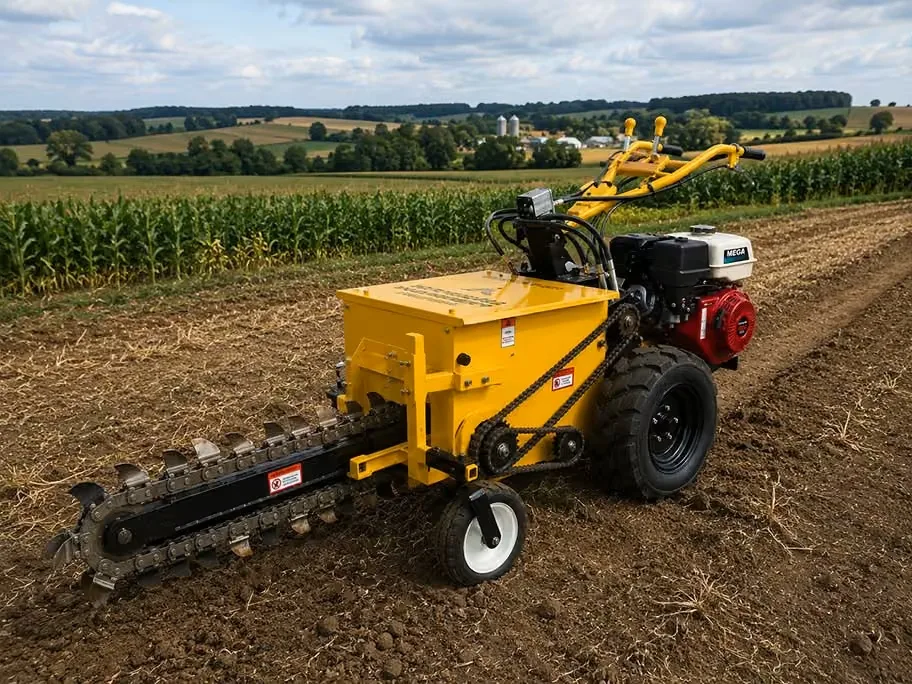
In utility, irrigation, and solar projects, a large part of the work is not deep, high-volume trenching but rather hundreds of short, narrow trenches spread across different sites. For these tasks, the biggest challenges are rarely about raw power. They’re about access, daily mobility, and the ability to produce consistent trench quality without wasting time or fuel. Compact walk-behind trenchers like the Dhruva 100 are built specifically for this reality.
The Dhruva 100 is an 11 HP self-propelled walk-behind trencher from Autocracy Machinery. It is not designed to replace large ride-on trenchers on major highway projects. Instead, it targets the segment where a lot of field teams spend most of their time: trenches up to 500 mm deep and 120–200 mm wide for small-diameter pipes, OFC conduits, irrigation lines, and solar cable routes.
One of the first advantages field crews notice is maneuverability. The machine’s compact dimensions and 250 kg weight allow it to fit into tight lanes, farm boundaries, and existing infrastructure corridors where bigger equipment struggles. It can be loaded onto a small trailer or pickup and moved between multiple sites in a single day, which is a common requirement for telecom drops, municipal utility extensions, and agri-service work.
The self-propelled design also changes how operators experience a typical workday. Instead of pushing or towing a trenching unit, the operator guides a machine that moves under its own power. This reduces fatigue and helps maintain straight, aligned trenches over long runs. For projects where trenches must follow a planned corridor—such as fiber routes along roads or cable trenches around solar arrays—this consistency matters for both quality and inspection.
Under the hood, the gear-drive transmission provides steady torque to the cutting chain. This contributes to smoother trenching in variable soils, better control over forward speed, and a lower risk of stalling in moderately compact ground. The result is a more predictable trenching process, which makes daily planning and output estimation easier for supervisors.
Adjustable trench width between 120–200 mm and a maximum depth of 500 mm allow teams to match the trench to the actual requirement. Instead of digging a standard wide trench for every job, operators can narrow it down to suit specific pipe or conduit sizes. This “right-sized” approach reduces unnecessary excavation, saves fuel, and cuts down on reinstatement work after pipes or cables are laid.
Typical applications for the Dhruva 100 include OFC cable drops in neighborhoods and campuses, small water pipeline extensions in semi-urban areas, drip irrigation networks across multiple fields, and DC cable trenches in ground-mounted solar parks. In each case, the work pattern involves many short segments, frequent repositioning, and limited space—conditions where a compact trencher can outperform a larger machine on total cost per meter.
For contractors and project leads, the practical takeaway is simple: if a significant share of your trenching is shallow, narrow, and spread across multiple sites, a dedicated compact machine can improve daily productivity and reduce logistical friction. The Dhruva 100 is an example of how right-sized equipment can make small trenching work genuinely smarter.