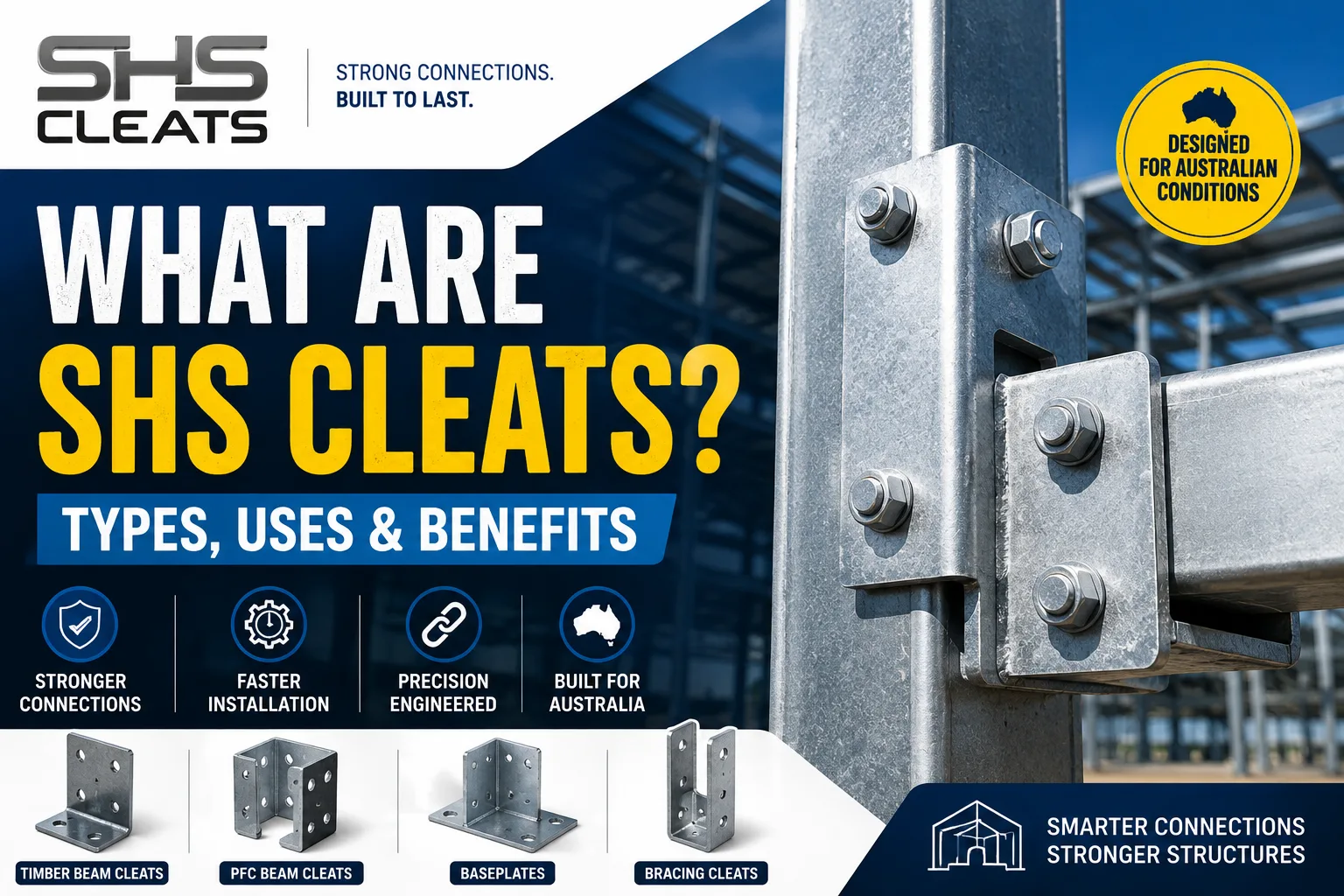
What Are SHS Cleats? Types, Uses & Benefits
Structural connections are one of the most important parts of any steel construction project. Beams, posts and other structural members may be manufactured from high-quality materials, but the overall performance of a structure also depends on how those components are connected.
One connection solution that has become increasingly useful for steel and timber construction is the SHS cleat.
SHS cleats are steel connection components designed to provide practical fixing points between Square Hollow Section (SHS) posts and other structural members. Depending on the design and application, they can be used with timber beams, steel members, bracing systems, and other components.
For builders, steel fabricators, engineers, and construction professionals, understanding SHS cleats can help when planning efficient and reliable structural connections.
In this guide, we explain what SHS cleats are, the different types and configurations, where they are used, their benefits, and the key factors to consider when selecting them.

What Does SHS Mean?
SHS stands for Square Hollow Section.
An SHS is a hollow steel section with a square cross-section. Because of their strength, relatively low weight and clean appearance, SHS sections are commonly used as structural posts, columns, frames and support members.
An SHS cleat is designed to work with these square hollow sections by providing a connection point for another structural component.
The exact design of a cleat depends on its intended application. Different connection arrangements may require different plate shapes, hole patterns, orientations and fixing methods.
For information about SHS cleat products and solutions, visit the SHS Cleats website.
What Are SHS Cleats?
An SHS cleat is a fabricated steel connection component used to connect a structural member to an SHS post or section.
Depending on the application, the connected member could be:
- A timber beam
- A steel beam
- A PFC section
- A bracing member
- A floor bearer
- A roof member
- Another structural component
The purpose of the cleat is to create a controlled and practical connection between the members.
Instead of relying entirely on extensive fabrication at the construction site, appropriately designed connection components can help make assembly more efficient.
However, the cleat must always be selected and installed according to the project's structural design and engineering requirements.
How Do SHS Cleats Work?
The principle is relatively simple.
An SHS post provides the primary vertical support, while the cleat provides a connection interface for another structural member.
Depending on the product design, the connection may involve:
- Bolts
- Screws or other specified fasteners
- Welding
- A combination of connection methods
The exact fixing arrangement should never be assumed from the appearance of a cleat. Fastener type, size, spacing, connection capacity and installation requirements should be confirmed from the relevant engineering documentation or manufacturer specifications.
This is particularly important for load-bearing structural applications.
Types of SHS Cleats
There is no single SHS cleat suitable for every application. Different structural arrangements require different connection configurations.
1. Timber Beam SHS Cleats
Timber and steel are frequently used together in residential and outdoor construction.
Timber beam cleats can provide a connection between a timber member and an SHS steel post.
Potential applications include:
- Pergolas
- Verandahs
- Decks
- Patio structures
- Roof structures
- Residential extensions
- Timber floor systems
The appropriate cleat depends on the timber dimensions, SHS post size, loading conditions, and connection design.
2. SHS Beam Cleats
Steel beam connections may require a different cleat configuration from timber connections.
Beam cleats can be used to create connection points between steel members and SHS posts, subject to the structural design.
Applications can include:
- Steel framing
- Roof structures
- Industrial buildings
- Commercial construction
- Structural platforms
The correct connection should be selected based on the actual steel sections and loads involved.
3. PFC Beam Cleats
PFC stands for Parallel Flange Channel.
PFC sections are commonly used in structural steel applications, and a dedicated connection cleat can provide an interface between the PFC member and an SHS post.
Potential applications include:
- Verandah structures
- Roof framing
- Steel support systems
- Structural frames
- Commercial construction
4. SHS Base Cleats and Baseplate Connections
Not every connection occurs at the top or side of a post.
The bottom of an SHS column also requires a suitable connection to its supporting structure.
Baseplate-type components can be used to create a connection between a steel post and a concrete foundation or other supporting structure, depending on the engineering design.
Applications may include:
- Steel posts
- Structural columns
- Pergola posts
- Steel frames
- Commercial structures
The base connection is particularly important because forces from the structure ultimately need to be transferred safely into the supporting foundation.
5. SHS Bracing Cleats
Bracing is used in many structures to provide stability against lateral movement and other forces.
Bracing cleats can provide connection points for:
- Rod bracing
- Steel angle bracing
- Structural support systems
- Sub-floor bracing
The appropriate bracing connection depends on the structural design and expected loads.
Where Are SHS Cleats Used?
The versatility of SHS connection components means they can be used across a broad range of construction applications.
Residential Construction
Residential projects may incorporate SHS cleats in:
- Pergolas
- Carports
- Verandahs
- Deck structures
- Patio roofs
- Steel-framed extensions
- Outdoor entertaining areas
For these projects, connection components can help combine the appearance of timber with the strength and durability of steel posts.
Commercial Construction
Commercial buildings often require repeatable connection details and efficient installation.
Potential applications include:
- Commercial awnings
- Covered walkways
- Structural frames
- Roof support systems
- Outdoor structures
- Steel and timber hybrid construction
Agricultural Structures
Australian agricultural buildings are often exposed to weather, dust, moisture and changing environmental conditions.
Steel connection components can be used in:
- Farm sheds
- Workshops
- Machinery shelters
- Storage structures
- Rural buildings
Where steel is exposed to the elements, appropriate corrosion protection becomes an important consideration.
Industrial Construction
SHS connections can also be incorporated into industrial structures such as:
- Warehouses
- Factories
- Platforms
- Support frames
- Manufacturing facilities
- Structural access systems
For industrial projects, product selection should be based on the project's engineering requirements rather than simply choosing a component based on size.
Key Benefits of SHS Cleats
1. Efficient Installation
Pre-fabricated connection components can reduce the amount of cutting, drilling and fabrication required during construction.
This may help:
- Reduce site preparation
- Improve installation efficiency
- Reduce fabrication work
- Improve consistency
2. Consistent Manufacturing
Factory-manufactured components can provide more consistent dimensions than components fabricated individually on a busy construction site.
Accurate fabrication can be particularly useful where multiple connections are required throughout a project.
3. Connection Flexibility
Different cleat configurations can accommodate different structural arrangements.
For example, a project may require:
- Single connections
- Corner connections
- Inline connections
- Multiple beam connections
- Bracing connections
The correct configuration should be determined during the design stage.
4. Reduced On-Site Fabrication
Reducing unnecessary fabrication at the construction site can help simplify the installation process.
This may reduce the need for:
- Cutting
- Drilling
- Welding
- Temporary fabrication setups
However, any welding or modification specified by the structural design must still be carried out by appropriately qualified personnel.
5. Suitable for Steel and Timber Construction
One of the useful features of SHS cleat systems is their ability to form part of steel-and-timber construction.
This makes them relevant to projects where timber beams are supported by steel posts.
Galvanised SHS Cleats
Corrosion protection is an important consideration for steel products.
For outdoor construction, galvanised steel can provide an additional layer of protection against corrosion.
This can be particularly relevant for:
- Coastal construction
- Outdoor structures
- Agricultural buildings
- Pergolas
- Carports
- Exposed steel framing
The appropriate coating and corrosion-protection system should always be selected according to the project's environmental conditions and specifications.
How to Choose the Right SHS Cleat
Choosing a cleat is more than simply matching the cleat to the post.
Consider the following factors.
SHS Post Dimensions
Confirm:
- Width
- Depth
- Wall thickness
- Steel grade
The connection component must be compatible with the SHS section.
Connected Member
Determine whether the connection involves:
- Timber
- PFC
- Steel beam
- Bracing
- Floor bearer
- Another structural member
Structural Loads
The design may need to consider:
- Vertical loads
- Shear
- Bending
- Wind loads
- Uplift
- Lateral forces
Connection Configuration
Determine whether the project requires:
- Single-sided connection
- Corner connection
- Inline connection
- Multiple connections
- Bracing connection
Environmental Exposure
Consider whether the connection will be:
- Indoors
- Outdoors
- In a coastal environment
- In an agricultural environment
- In an industrial environment
Installation Considerations
Correct installation is essential for structural performance.
Before installation:
- Confirm the product and dimensions.
- Review the engineering drawings.
- Check the SHS post dimensions.
- Confirm fastener requirements.
- Inspect components for transport damage.
- Ensure the connection surfaces are suitable.
- Confirm alignment before final fixing.
During installation, do not modify a structural connection simply because it appears easier or more convenient.
Any alteration to a designed connection should be reviewed by the responsible engineer.
For a dedicated installation resource, you can internally link this section to your SHS Cleat Installation Guide once the corresponding page or PDF is published on SHSCleats.com.
SHS Cleats vs On-Site Fabrication
One reason builders may choose pre-fabricated connection components is to reduce the amount of work required at the construction site.
On-site fabrication can involve:
- Measuring
- Cutting
- Drilling
- Welding
- Grinding
- Recoating
A manufactured cleat can move some of this work into a controlled production environment.
This can improve consistency and make installation more predictable.
However, the best solution depends on the project's design, quantity, connection requirements and engineering specifications.
Why Engineering Matters
An SHS cleat should not be selected based solely on its physical appearance or the size of the steel post.
Structural connections can experience complex combinations of forces.
A qualified engineer should determine:
- Required connection capacity
- Appropriate cleat configuration
- Fastener requirements
- Weld requirements
- SHS section requirements
- Structural load paths
- Applicable design requirements
This is especially important for load-bearing structures.
SHS cleats are connection components; they do not replace structural engineering design.
Final Thoughts
SHS cleats provide a practical connection solution for projects involving Square Hollow Section steel posts and structural members such as timber beams, steel beams, PFC sections and bracing components.
Their potential advantages include efficient installation, consistent fabrication, reduced on-site work and flexibility across different construction applications.
From residential pergolas and verandahs to commercial and industrial structures, the right connection component can make a significant difference to the construction process.