When somebody asks, “What kind of music can I play on a Kremona Solea?” there are really two questions hiding inside it.
The first is easy:
Can you play classical music, Spanish repertoire, Latin music, folk arrangements or contemporary songs on it?
Of course.
The more interesting question is whether the Kremona Solea Classical Guitar is the right instrument for the way you want to approach that music.
That requires us to stop thinking in terms of genre labels for a moment and look at the guitar itself.
The Solea Begins As A Classical Guitar
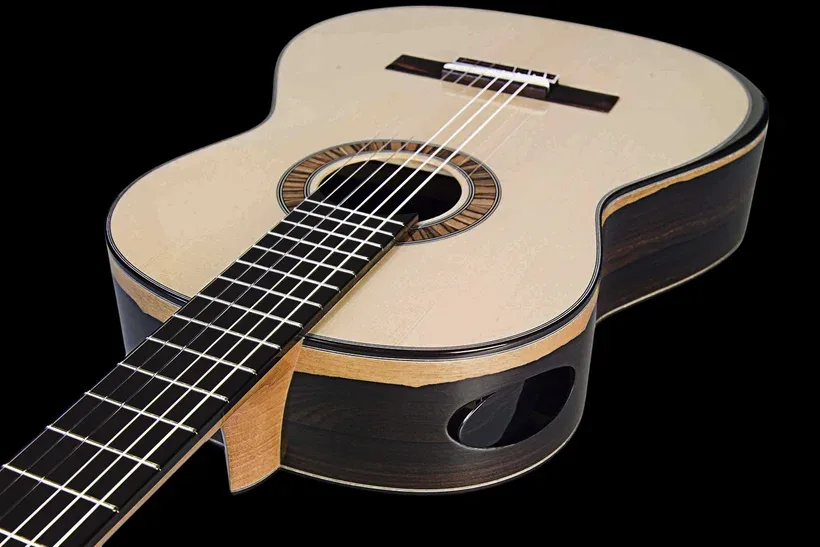
The Kremona Solea belongs to Kremona's Artist Series.
That tells us something about the instrument's intended context before we play a note. It is not being presented as a steel-string substitute or as a stage-oriented crossover instrument. It belongs to Kremona's traditional nylon-string classical family.
That matters because a traditional classical design influences the relationship between both hands and the instrument.
String spacing, scale, neck geometry, body response and setup all contribute to how the guitar feels.
Those characteristics make the instrument a natural home for classical repertoire—but they do not dictate the music that has to come out of it.
Classical Repertoire Is The Obvious Starting Point
For traditional classical playing, the advantages are straightforward.
The right hand can work independently across the strings. The left hand has room for contrapuntal passages and independent voices. Melody, bass and interior harmony can all coexist without requiring a band around you.
That is one of the remarkable things about classical guitar.
One player can imply several musical voices at once.
Whether you are working through Sor and Tárrega or playing contemporary classical repertoire, the important question is how clearly the instrument lets you hear those voices and how naturally it responds to your hands.
That is something specifications cannot answer completely.
You have to play the guitar.
Spanish Music Does Not Require A Different Identity
Spanish guitar music covers far more territory than the word “flamenco.”
A classical instrument such as the Solea can be entirely at home with Spanish classical and Romantic repertoire.
Flamenco deserves more care.
You can certainly play flamenco repertoire or flamenco-influenced material on a classical guitar, but a purpose-built flamenco guitar typically has a different construction and setup objective.
If flamenco is the central purpose of the purchase, we would compare the Solea with an actual flamenco instrument, such as the Kremona Rosa Lucia, rather than assuming every nylon-string guitar serves both roles equally.
That comparison can tell you far more than the genre name printed on a piece of music.
Latin And Brazilian Music Can Feel Very Natural
Nylon strings are also at home in a great deal of Latin American and Brazilian music.
Bossa nova is an obvious example because the guitar is often responsible simultaneously for harmony, bass movement and rhythm.
That makes the right-hand independence developed in classical technique particularly useful.
But again, we would resist saying that a particular wood or specification automatically creates the “right” tone for this music.
The player, strings, setup, touch and arrangement all participate in the result.
Listen to the instrument rather than asking the specification sheet to predict the music for you.
Folk And Contemporary Music Become Arrangement Questions
The Solea can also be used for folk songs, contemporary music and instrumental arrangements of popular songs.
This is where the distinction from our broader discussion of classical-guitar versatility becomes important.
We would not choose the Solea simply because “a classical guitar can play pop.”
We would choose it if we actually preferred what this particular classical instrument brought to the arrangement.
Perhaps a familiar song becomes more interesting when the vocal melody moves to the guitar.
Perhaps a strummed accompaniment becomes a fingerstyle arrangement.
Perhaps the bass line becomes independent from the chord voicing.
Those are musical decisions.
The guitar becomes worthwhile when its characteristics encourage you to make them.
Don'T Ask The Solea To Pretend To Be Another Guitar
This may be the most useful way to approach the instrument.
If you want the bright attack and aggressive strumming response of a steel-string acoustic, buy a guitar designed to give you that.
If what you need instead is a nylon-string guitar designed with amplified performance in mind, a model from Kremona's Performer Series, such as the Sofia S63CW, gives you another direction to consider.
If flamenco is your primary musical language, compare it with a flamenco guitar.
But if you want a traditional classical instrument and also intend to explore music beyond conventional classical repertoire, there is no reason the word “classical” should stop you.
The question is whether you like what happens when your music passes through this particular instrument.
Before Looking For A Kremona Solea Guitar For Sale
If you're actively searching for a Kremona Solea Guitar for sale, this is where we would slow the process down.
First confirm that the Solea's traditional classical orientation is what you actually want.
Then evaluate the individual instrument.
- How does the neck feel?
- How does the guitar respond when you play quietly?
- What happens when you ask for more projection?
- Can you hear separation between simultaneous voices?
- Does the bass support the instrument without overwhelming it?
- Do the trebles remain useful as you move up the fingerboard?
- And perhaps most importantly:
- Does the guitar make you want to keep playing?
- Those questions are much more useful than asking whether the Solea is “good for” a list of musical genres.
The Music Tells You Something. The Guitar Tells You The Rest.
The Kremona Artist Series Solea Classical Guitar should first be understood for what it is: a classical nylon-string instrument.
From there, the repertoire is remarkably open.
Classical music is an obvious fit. Spanish repertoire, Latin and Brazilian music, folk arrangements and contemporary songs can all find a place on the instrument.
But versatility should not mean asking one guitar to imitate every other guitar.
It means discovering how much music you can make while allowing the instrument to retain its own identity.
At Marfione Guitars, that is how we prefer to evaluate instruments.
Not:
“What is this guitar supposed to play?”
But:
“What does this guitar allow this player to do?”
Call to Action
If you're considering a Kremona Solea and want to understand how it compares with other classical, crossover or performance-oriented nylon-string guitars, Marfione Guitars can help you evaluate the differences from a player's and luthier's perspective.