
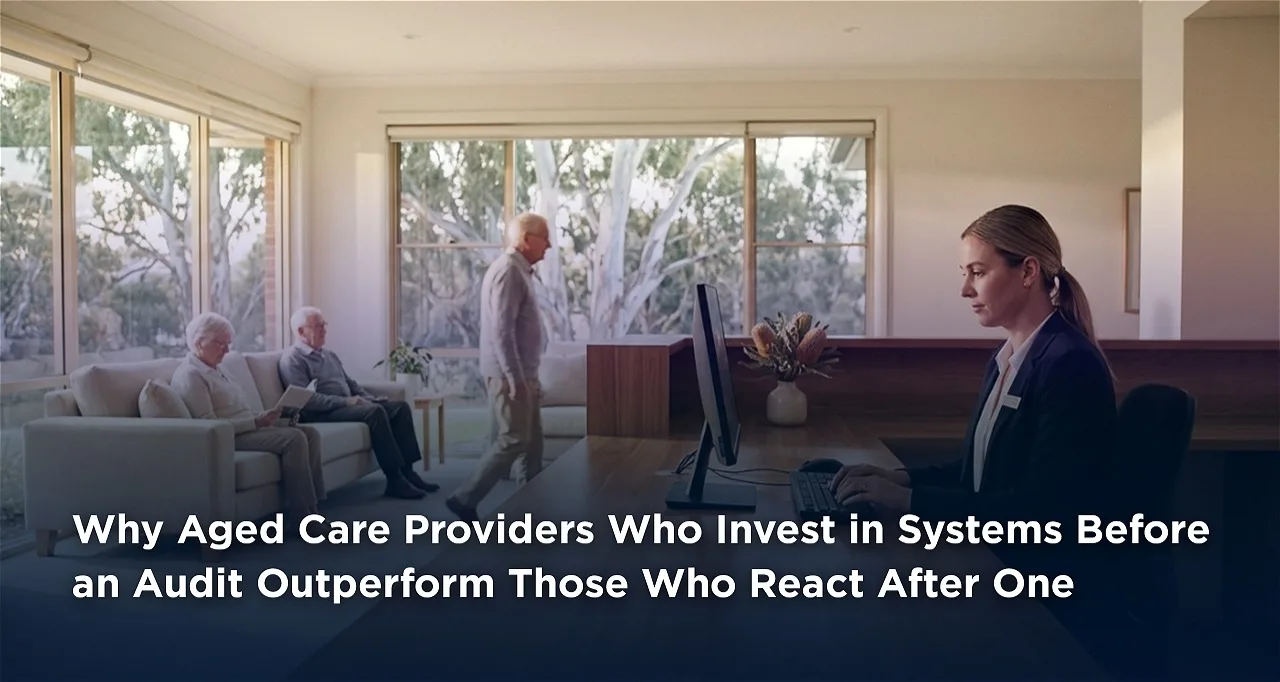
The phone rang at 6:47 am on a Wednesday in March. ACQSC inspectors would arrive at the facility within ninety minutes for an unannounced visit. Margaret, the operations manager, already knew where her dietary records, maintenance logs and family feedback notes lived. They had all been on the same platform for the past two years. By 7:30 am she was at the front entrance with a coffee, while her clinical manager pulled up the resident profiles inspectors were likely to ask about.
A few suburbs over, another facility received the same call. Their morning looked nothing like Margaret's. Folders came off the shelves. Two carers had to leave the floor to help print care plans, and somewhere in the back office, the maintenance officer was opening one inbox after another, trying to remember which one held the last fire safety report.
Both teams were facing the same regulator and the same Strengthened Standards, but only one of them was actually ready when the call came. This is the difference between facilities that have invested in a Complete Aged Care Management Software solution before the pressure arrives and those still planning to.
What inspectors actually ask to see
Most Strengthened Standards reviews trace the same handful of threads, and they tend to be predictable across facilities. Inspectors will pick a recent complaint and follow it from the moment it was logged through to how the resident's family was informed of the outcome, which is the core of Standard 2 evidence. The Standard 4 thread tends to run through an up-to-date asset register and the maintenance and fire safety records that back it up. Standard 6 usually starts with a resident on a texture-modified diet and follows that requirement from their care profile into the kitchen production sheet, ending with the speech and language assessment behind the modification.
A facility working from paper or scattered spreadsheets can usually produce all of this. The real question is how long it takes, and how much of it falls apart when the staff member who knows where everything is happens to be on annual leave.
The audit timeline most aged care facilities know too well
Before the Strengthened Aged Care Quality Standards came into effect in November 2025, many facilities ran on a reactive rhythm. Records lived everywhere. The official version sat in paper folders, while the unofficial version sat in spreadsheets that one or two people fully understood. Clinical conversations frequently happened in WhatsApp groups that disappeared the day someone got a new phone.
Then a notice would arrive, or sometimes the front door would simply open with inspectors already inside. The next forty-eight hours got spent reconstructing months of activity from memory and printouts, while care quality dipped because the team's attention had shifted from residents to documentation.
The facilities that have stepped out of this rhythm are not necessarily larger or better resourced than the ones still in it. They made a decision earlier in the year that audit readiness needed to be a daily state, the way infection control is a daily state.
Why does reacting after an audit cost more than preparing before one
When ACQSC findings come back with non-compliance issues, the response is rarely cheap. The direct cost of remediation is the obvious one. Less obvious are the additional reporting cycles and re-inspection visits, and the slower cost that travels through a community, visits and lies, compares notes, and words move faster than any regulator notice.
The hidden cost of manual processes
Manual record-keeping carries a tax that most facilities only feel during an audit. A carer writes the same observation into three places when one would do. Allergen records sit in a kitchen binder that the relief chef has never opened, and a maintenance schedule lives in someone's head until that person leaves the role and takes it with them. Each of these is a gap an inspector can find and a gap a resident can fall through.
Communication gaps that show up in the inspector's notebook
Standard 2 places real weight on how an organisation demonstrates continuous improvement and feedback handling. When complaints sit in personal email inboxes, or when family concerns get mentioned at handover and never logged, the trail breaks. Inspectors notice broken trails quickly. A digital platform closes these gaps simply by ensuring the work already being done on the floor leaves a usable record behind it.
What changes when audit readiness becomes the default
Facilities running a Complete Aged Care Management Software platforms describe the same kind of difference, and it is rarely dramatic. The care manager pulls up two years of feedback themes during the entry meeting without leaving the room. Over in the kitchen, the head chef is showing the inspector how a resident's dietary profile flows into that morning's production sheet. Maintenance produces an asset register, complete with photos and contractor sign-offs, in the time it would have taken to find the right binder.
The concern operators raise most often is whether staff will actually use the platform once it goes in. Adoption is never automatic, which is why phased rollouts and role-specific training tend to matter as much as any feature comparison. The platforms that survive the first six months on the floor are usually the ones built around the rhythm of a working shift in an aged care facility.
A real-life example: two facilities, twelve weeks apart
Consider a hypothetical scenario based on patterns the sector sees regularly. Two aged care facilities of similar size, both in regional Victoria and both with strong clinical teams.
Facility A invested in a Complete Aged Care Management Software platform around eighteen months before their performance assessment. Daily charting moved into a single system. Feedback from residents and families was captured at the point of conversation rather than reconstructed at the end of the month. Maintenance issues moved off the clipboard at reception and into a workflow with photos, priority levels and contractor sign-offs.
Facility B had the same intention. The decision kept getting pushed to next quarter. When the assessment notice arrived, the team had ten days to reconstruct what should have been ongoing evidence.
The outcomes followed the inputs. Facility A came out with minor recommendations focused on continuous improvement. Facility B finished with findings that required a formal response and a follow-up visit. The team at Facility B were no less skilled or committed than the team at Facility A. The difference sat in what their tools could prove on the day the inspectors actually asked. This is where the best software for aged care providers tends to earn its keep, in the quiet record it builds across the small daily moments most teams forget to write down.
Read moreWhy Aged Care Providers Who Invest in Systems Before an Audit Outperform Those Who React After One here:https://centrimlife.com.au/blog/why-aged-care-providers-who-invest-in-systems-before-an-audit-outperform-those-who-react-after-one/