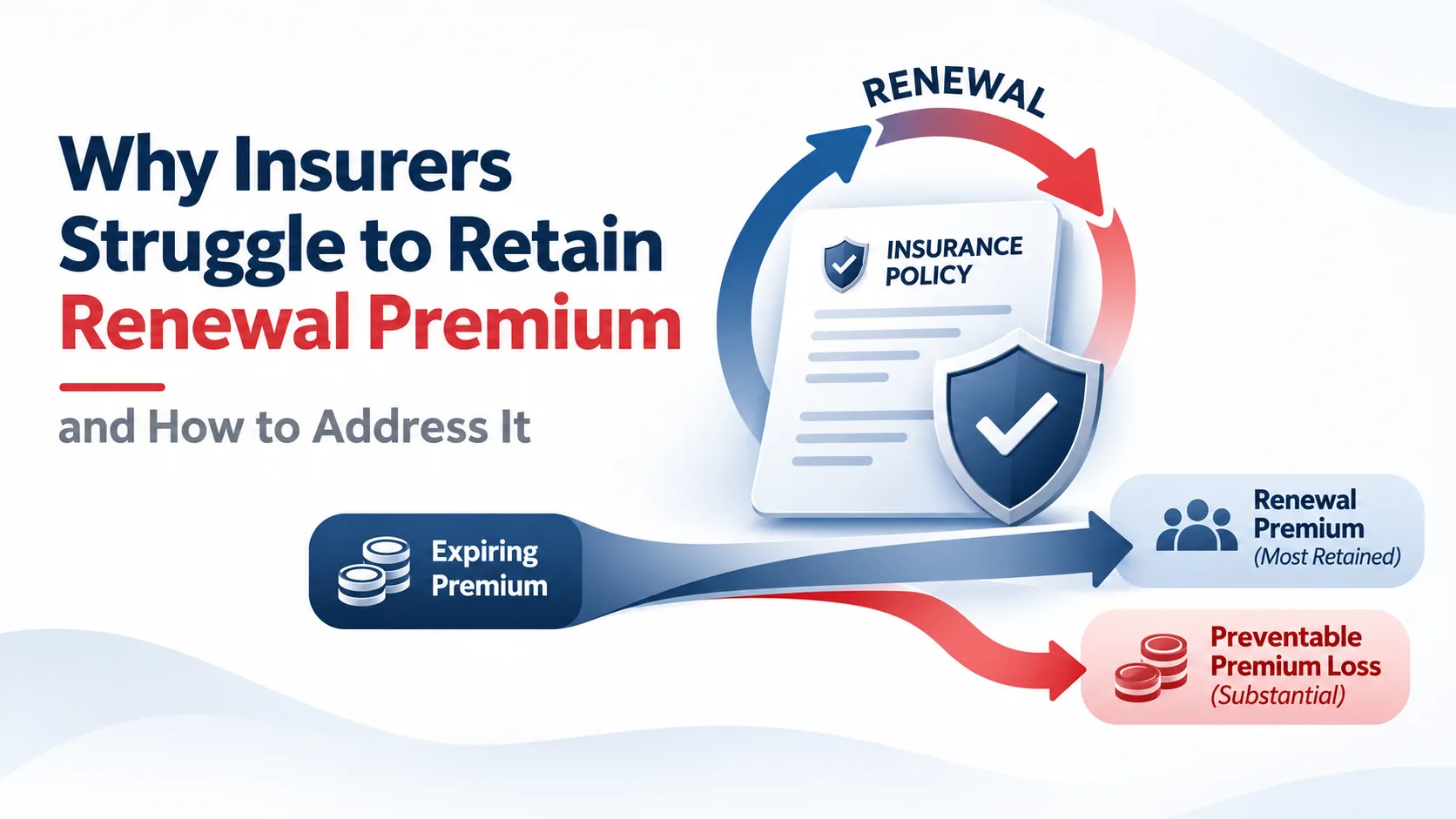
An insurance company may report a strong policy renewal rate and still experience disappointing premium retention. Losing a few high-value accounts, reductions in coverage, and changes in customer requirements can significantly affect the premium generated from an existing portfolio.
Acquiring new customers is important, but retaining existing business is equally critical to sustainable growth. When insurers consistently lose renewal premium, new business must compensate for those losses before contributing to overall premium growth.
Improving retention requires coordination across underwriting, customer service, policy administration, distribution channels, and technology.
The challenge lies in understanding where premium is being lost, distinguishing unavoidable losses from preventable ones, and developing targeted strategies to address them.
Also, wherever these functions face operational or technological limitations, an insurance business services provider can help insurers identify and address interconnected challenges.
Policy Retention and Premium Retention Are Not the Same
Policy retention measures the proportion of eligible policies that renew. Premium retention measures the proportion of expiring premium associated with renewed policies, before any rate or exposure changes. Insurers may use different retention definitions depending on their product lines and reporting methodologies. [1]
Consider an insurer with 1,000 policies available for renewal, representing $5 million in annual premium.
If 900 policies renew, the policy retention rate is 90%. However, if those policies represent only $3.75 million of expiring premium, the premium retention rate is 75%.
Why the difference?
The 100 non-renewed policies carried an average annual premium of $12,500, compared with approximately $4,167 for the retained policies.
Despite retaining most of its policies, the insurer has lost a quarter of its original premium base, even before changes in renewal pricing or coverage are considered.
Why Insurers Struggle to Retain Renewal Premium
1. Rising Premiums and Competitive Pressure
Premium increases are sometimes necessary to reflect claims experience, inflation, and changing risk conditions. However, customers facing higher premiums often reconsider their insurance options.
A 2025 study of U.S. small commercial insurance customers found that only 55% definitely intended to renew with their existing insurer, down six percentage points from 2024. [2]
Retaining customers through excessive discounting, however, can undermine underwriting profitability. Insurers must balance competitive positioning with appropriate pricing and portfolio sustainability.
2. Poor Communication About Renewal Changes
Customers receiving revised premiums, coverage terms, or deductibles without adequate explanation may question the value of their existing insurance.
The 2025 small commercial insurance study found that customers who fully understood their premium increases reported satisfaction levels comparable to customers who experienced no increase. [2]
The 2026 edition also reported a 15-point improvement in overall customer satisfaction, with better digital experiences and pricing perceptions contributing to the increase. [3]
These findings reinforce the importance of customer communication, accessible support, and effective service delivery alongside pricing.
3. Operational Gaps in the Renewal Process
Delayed quotations, incomplete documentation, unresolved service requests, and missed follow-ups can contribute to unsuccessful renewals.
A commercial customer, for example, might accept a competing offer because its current insurer has not finalized renewal terms before the decision deadline.
Strengthening insurance process standardization and optimization helps establish consistent workflows, clear responsibilities, and better control over renewal deadlines.
4. Changes in Customer Coverage Requirements
Premium reductions do not always indicate customer dissatisfaction.
Businesses may sell insured assets or reduce operations. Individuals may reconsider coverage following changes in employment, income, or family circumstances.
Health insurance customers may select different plans based on affordability and coverage needs, while renewable term life insurance premiums may increase at the beginning of a new term. [4][5]
Understanding these differences helps insurers distinguish changing requirements from competitive or operational retention problems.
How Insurers Can Improve Renewal Premium Retention
1. Build a Premium Retention Bridge
A premium retention bridge breaks down the movement from expiring premium to actual renewal premium, helping management identify the financial impact of different factors.
Consider the previous hypothetical insurer with $5 million in expiring premium:
- Expiring premium: $5,000,000
- Premium lost through non-renewals: −$1,250,000
- Coverage reductions on retained policies: −$150,000
- Premium increases from rate changes: +$300,000
- Net reductions from exposure changes: −$100,000
- Actual renewal premium: $3,800,000
The insurer retains 75% of its expiring premium before renewal adjustments, while its actual renewal premium represents 76% of the original premium base.
The bridge reveals that pricing increases partially offset lost business and coverage reductions.
Insurers should apply a consistent calculation sequence to separate rate, coverage, and exposure effects without double-counting.
Through structured business process consulting, insurers can investigate the operational causes behind these financial outcomes, assess existing renewal workflows, and prioritize improvements based on their potential financial impact.
2. Establish a Structured Renewal Timeline
Renewal preparation should begin well before policy expiration.
For complex commercial accounts, an illustrative renewal schedule could include:
- 90 days before expiration: Review account information, coverage requirements, and outstanding service issues.
- 60 days before expiration: Collect missing information and initiate underwriting reviews.
- 30 days before expiration: Target delivery of finalized renewal terms and resolve outstanding questions.
- Before expiration: Confirm customer decisions and complete required documentation.
These are illustrative internal milestones rather than universal regulatory deadlines. Actual timelines should reflect product requirements, account complexity, and applicable notice obligations.
Defined milestones make delays visible and establish accountability before renewal opportunities are lost.
3. Use Technology to Identify At-Risk Renewals
Policy administration systems, customer relationship management platforms, and workflow automation tools provide valuable information for identifying renewal risks.
Insurers should establish alerts for approaching deadlines, incomplete renewal files, unresolved complaints, outstanding broker responses, and significant premium changes.
More advanced organizations can evaluate predictive lapse or non-renewal models to prioritize service outreach.
Aggregate price-sensitivity analysis can also help management understand retention patterns following rate changes. However, individual policy pricing must follow applicable insurance requirements and authorized rating practices.
Predictive models require appropriate data governance, accuracy testing, human oversight, and safeguards against unfair discrimination. [6]
Technology should support informed intervention rather than replace professional judgment.
4. Strengthen Broker and Agent Coordination
For insurers operating through intermediaries, retention depends partly on the quality of coordination between carriers, brokers, and agents.
Distribution partners need early access to accurate renewal terms, underwriting requirements, documentation, and explanations of pricing changes.
Insurers should monitor outstanding information requests, broker response times, renewal quotation delivery, and retention performance across distribution channels.
Regular discussions with intermediaries can also reveal recurring customer concerns that internal policy administration data may not capture.
5. Classify Renewal Losses and Address Their Causes
Every unsuccessful renewal should have a documented reason wherever that information is available.
Potential classifications include competitive pricing, changed coverage requirements, service dissatisfaction, quotation delays, documentation errors, customer eligibility changes, and insurer-initiated non-renewals.
These outcomes should then be grouped into potentially avoidable, externally driven, intentional, or undetermined losses.
For example, inaccurate renewal documentation represents an internal improvement opportunity. A customer's business closure may be unavoidable, while a permitted non-renewal may reflect an intentional underwriting decision.
Monthly reviews should identify recurring causes, estimate their premium impact, assign corrective actions, and track whether similar losses decline.
The objective is not to retain every policy but to protect suitable business from preventable losses.
Measuring Renewal Retention Performance
Insurers should establish measurable indicators that connect operational performance with premium outcomes.
- Policy retention rate: Renewed policies ÷ eligible expiring policies × 100.
- Premium retention rate: Expiring premium on renewed policies ÷ total eligible expiring premium × 100.
- Renewal premium change: (Actual renewal premium − expiring premium on renewed policies) ÷ expiring premium on renewed policies × 100.
- On-time quotation rate: Renewal quotations delivered by the established deadline ÷ renewal quotations due × 100.
- Potentially avoidable premium loss rate: Expiring premium on non-renewed policies classified as potentially avoidable ÷ total eligible expiring premium × 100.
These indicators should be analyzed across products, customer segments, account sizes, and distribution channels.
For long-duration life insurance products, persistency and lapse rates may be more appropriate than conventional annual renewal measures.
Retention performance must also be evaluated alongside profitability and underwriting objectives.
Conclusion
The difference between policy retention and premium retention reveals an important challenge: insurers can retain most of their policies while still losing a substantial portion of their premium base.
Protecting renewal premium requires financial visibility, structured renewal workflows, effective technology, strong distribution relationships, and systematic analysis of unsuccessful renewals.
A practical starting point is a retention health check that examines recent renewal outcomes, identifies recurring operational failures, and estimates their financial impact.
Trinite Consulting helps insurers evaluate operational weaknesses and identify process improvement and technology-enabled solutions that support sustainable business performance.
References:
[1] Travelers (2026) – Third Quarter Form 10-Q, September 30, 2026.
[2] J.D. Power (2025) – U.S. Small Commercial Insurance Study.
[3] Carrier Management (2026) – Rates, Digital Support Boost Small Business Insurance Customer Satisfaction: JD Power.
[4] HealthCare.gov – Renew, Change, Update, or Cancel Your Plan.
[5] NAIC – Life Insurance: Understand Renewal Policies.
[6] NAIC – Artificial Intelligence in Insurance.