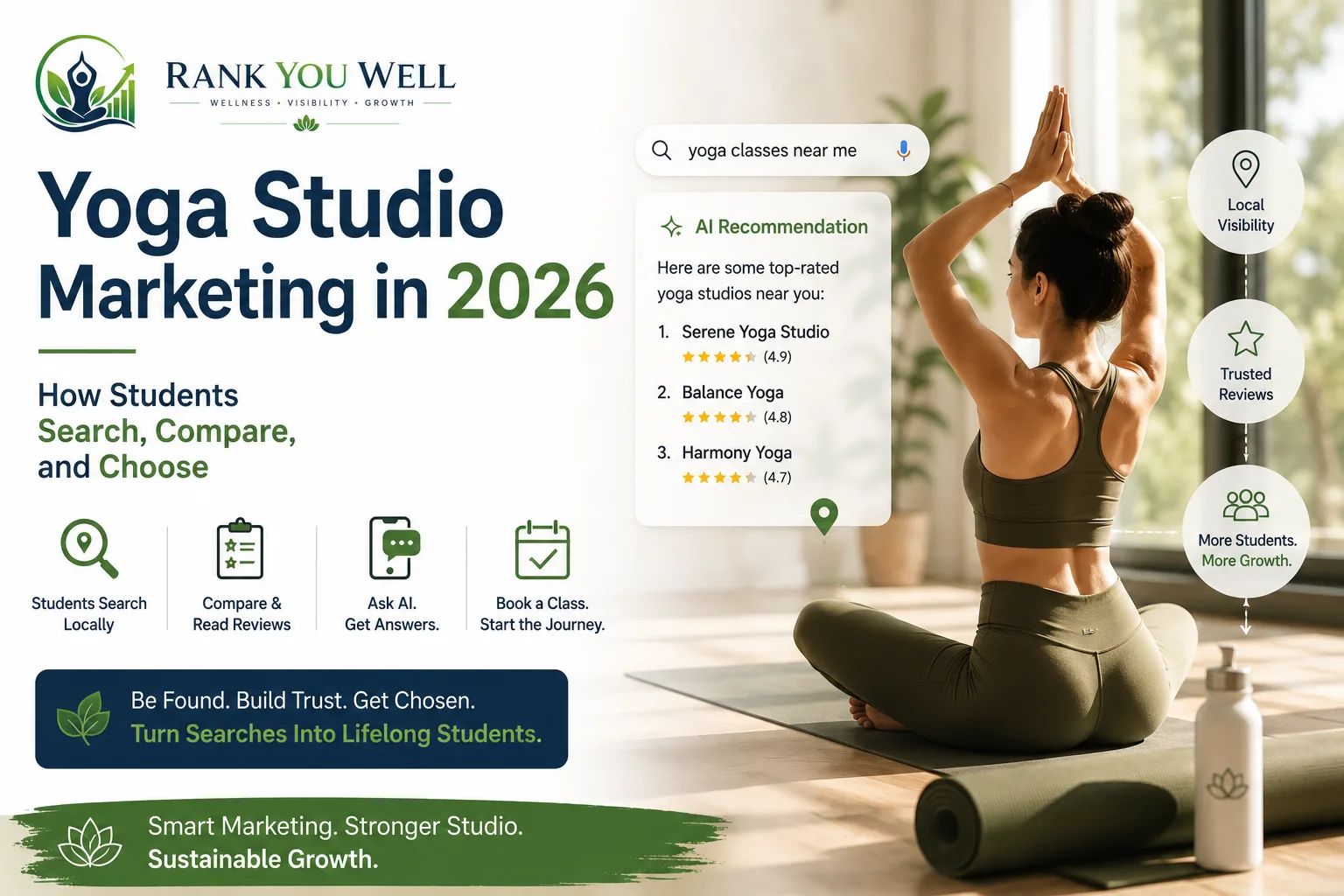
A student deciding on a yoga studio today rarely just walks in off the street. They search, they compare, they read reviews, and increasingly, they ask an AI assistant to recommend one — often before they've visited a single website.
Location-based search has grown sharply. Industry tracking shows more than 200 million monthly "near me" searches in early 2026, and local intent now shows up in close to half of all Google searches. For a studio, that means the person searching "yoga classes near me" or "beginner yoga [city]" isn't idly browsing — they're deciding, and a large share of people who run a local search visit or contact a business within 24 hours.
How Do People Actually Search for a Yoga Studio Now?
Almost entirely with local intent, and increasingly with the expectation of an instant, ready-to-act answer. Yoga studio marketing in 2026 comes down to five things working together — a complete Google Business Profile, class-specific pages, genuine reviews, content that answers real student questions, and a site structured clearly enough for both Google and AI search tools to understand and recommend you.
That urgency is why local visibility, not general brand awareness, does most of the heavy lifting for a yoga studio's marketing.
Why Your Google Business Profile Still Comes First
It's still the single highest-leverage asset a local studio has, and it now feeds AI search answers as well as traditional Maps results.
An accurate, fully filled-out profile does two jobs at once. It helps you show up in the Google Maps "local pack" for nearby searches, and it's one of the main sources AI-powered search tools pull from when someone asks a conversational question like "what's a good beginner yoga studio near me?" Reviews matter more than most studios assume — research on local ranking factors has found a measurable lift in profile conversions for every additional batch of reviews, and listings in the top local search positions tend to carry hundreds of reviews on average.
Keep your category, hours, class types, and photos current, and make sure your website says the same thing your profile says. Inconsistent information between the two is one of the more common (and avoidable) trust signals studios get wrong.
Build a Page for Every Class You Actually Teach
One generic "classes" page competes with itself; dedicated pages for each class type give both search engines and AI tools something specific to match to a specific question.
If your studio offers Hatha, Vinyasa, prenatal, or beginner-focused classes, each deserves its own page — what the class involves, who it's suited for, what to expect in a first session, and how to book. This isn't just an SEO habit; it directly supports how AI-driven search tools work in 2026. Current guidance on answer engine optimization (AEO) — the practice of structuring content so AI systems can confidently extract and cite it — consistently points to the same pattern: clear, single-topic pages with direct answers get pulled into AI-generated responses far more often than long, generalized pages trying to cover everything at once.
Content That Builds Trust Before Someone Ever Visits
The students worth reaching are often asking a broader question before they're asking about your studio specifically.
Someone searching "is yoga good for flexibility" or "what type of yoga is best for beginners" isn't ready to book yet, but they're forming an opinion about who understands their situation. Content that answers those questions honestly — without turning every paragraph into a pitch — is what shows up in both search results and AI-generated summaries later, when that same person searches for a studio by name or by location.
Social Media Should Show the Studio, Not Just Sell It
Short, educational content is currently outperforming purely promotional posts by a wide margin.
Recent platform data shows short how-to and educational video content earning meaningfully higher engagement than posts built purely around promotion. For a studio, that translates to instructor introductions, quick technique breakdowns, honest student experiences, and behind-the-scenes moments — content that reduces uncertainty about what walking into your studio actually feels like, rather than content that only asks for a follow.
The Real Job: Turning Visibility Into a Booked Trial Class
Getting found is only half the outcome. Once someone reaches your site, they should be able to immediately answer: what's offered, who it's for, where you're located, when classes run, and how to book — with one clear action, not five competing ones. Studios with active online booking tend to convert visitors at a noticeably higher rate than those relying on a phone call or a contact form alone, and it removes the single biggest source of drop-off between "interested" and "enrolled."
Preparing for AI-Driven Search, Not Just Google
AI search doesn't replace local SEO — it's built on top of it, and it rewards the same fundamentals done more precisely.
Current guidance on local AEO is consistent on this point: platforms like Google AI Overviews, ChatGPT, and Gemini pull from the same signals that already matter for local SEO — consistent business details across the web, structured FAQ content, clear entity information, and genuine reviews. The studios most likely to get named directly in an AI-generated answer are the ones whose information is easiest to verify, not the ones producing the most content.
Practical steps that help: FAQ sections with direct, self-contained answers; consistent name, address, and phone information everywhere your studio is listed; and structured data (schema markup) that spells out your services and location in a format machines can parse cleanly.
The 2026 Yoga Studio Discovery Path
Search → Google Maps → Website → Reviews & Social Proof → Trial Class → Membership
Every stage reinforces the next. Local SEO earns the first look. Your Google Business Profile and reviews build initial trust. Your website and content close the gap between curious and convinced. And a genuinely easy booking process is what turns that trust into a student walking through the door.
Frequently Asked Questions
What's the most important marketing channel for a yoga studio in 2026?
Local SEO and an accurate Google Business Profile remain the foundation, since the overwhelming majority of prospective students search with location intent before choosing a studio.
Does AI search replace the need for traditional SEO?
No. AI-powered search results are built on the same local SEO fundamentals — accurate business information, structured content, and genuine reviews — rather than replacing them.
How many reviews does a yoga studio actually need?
There's no fixed number, but review volume and recency both influence local ranking and conversion, and studios that consistently earn a steady stream of genuine reviews tend to outperform those with a handful of old ones.
What content actually helps a yoga studio get found?
Class-specific pages and content answering real beginner questions (flexibility, class types, what to expect) tend to perform best, because they match how people actually search before they're ready to book.
Final Thoughts
Yoga studio marketing in 2026 isn't about being everywhere — it's about being unmistakably clear in the handful of places students actually look: Google, Maps, reviews, and increasingly, AI search assistants. Get your Google Business Profile right, build pages around your actual classes, earn genuine reviews, and make booking effortless — everything else compounds from there.
Rank You Well builds exactly this kind of layered, search-first strategy for yoga studios and wellness businesses — local SEO, AI search visibility, content, and conversion, working as one system rather than separate tactics. If your studio is ready to move from findable to chosen, that's where to start.