
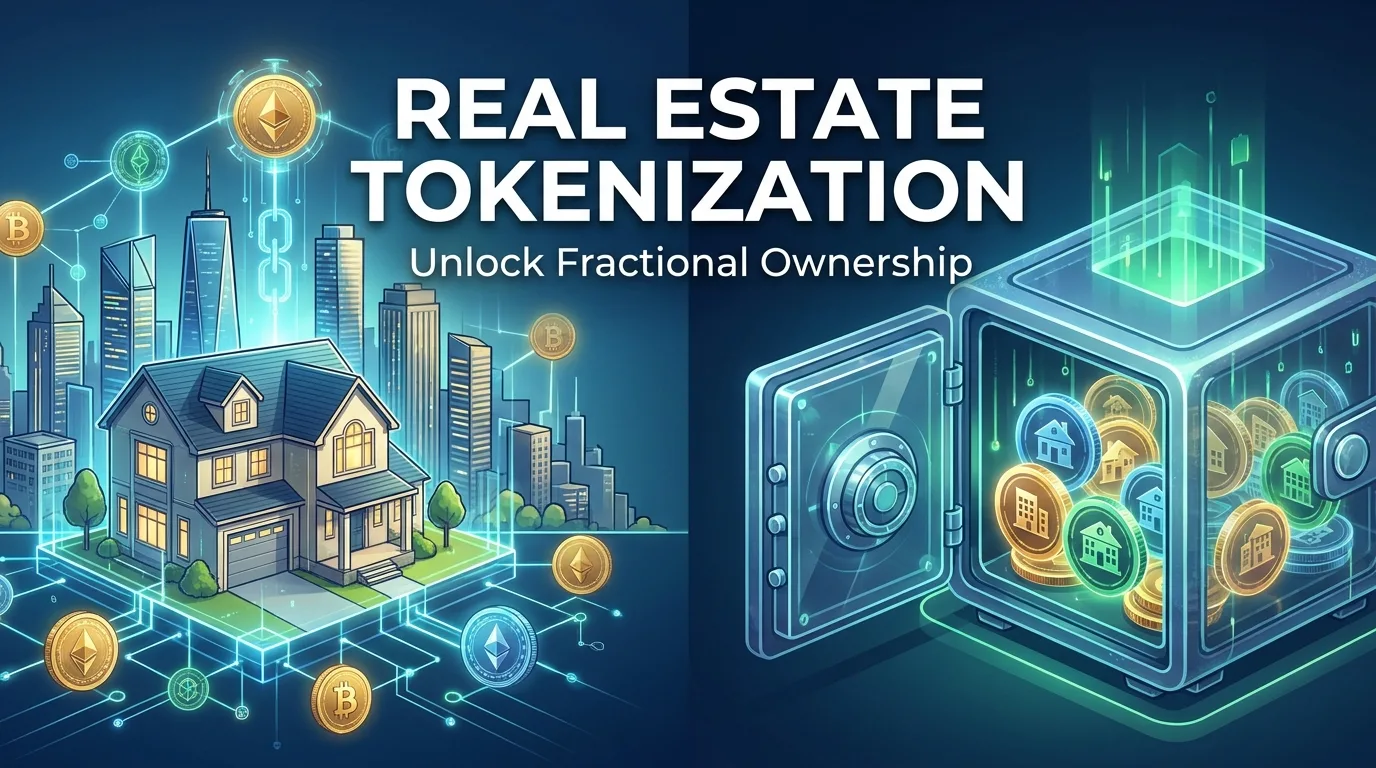
Real estate has traditionally been viewed as one of the most reliable asset classes, but investing in property has never been completely simple. High capital requirements, lengthy transaction processes, geographic limitations, complex legal structures, and a lack of liquidity have often made real estate inaccessible to many investors. Blockchain technology is beginning to challenge this traditional model through real estate tokenization, a process that converts ownership rights or economic interests in real-world property into digital tokens recorded on a blockchain.
Tokenization does not simply mean putting a property listing on a blockchain. It involves creating a legal and technical structure that connects an off-chain asset, such as an apartment building, commercial property, or real estate fund, with digital representations of ownership or financial rights. When designed correctly, this model can enable fractional investment, automate certain administrative processes, improve transparency, and potentially create more flexible secondary-market opportunities.
The market opportunity is attracting increasing institutional attention. Deloitte projected that the value of tokenized real estate could reach $4 trillion by 2035, compared with less than $300 billion in 2024, although this is a forecast rather than a guaranteed outcome. The prediction illustrates why tokenization is increasingly being discussed as a potential transformation of real estate finance and asset management.
This guide explores how real estate tokenization works, its major benefits, the implementation process, and the challenges businesses and investors must consider before entering the market.
What Is Real Estate Tokenization?
Real estate tokenization is the process of representing ownership, equity, debt, revenue rights, or another legally defined interest connected to a property through blockchain-based digital tokens.
In a conventional real estate investment, an investor might purchase an entire property or acquire shares in a real estate investment vehicle. The ownership structure is documented through contracts, company records, property registries, and financial intermediaries. In a tokenized model, a legal entity may hold the underlying property while blockchain-based tokens represent defined interests in that entity or investment arrangement.
For example, imagine a commercial property valued at $10 million. Instead of requiring one investor to purchase the entire asset, the ownership or economic interest could potentially be divided into 1 million digital tokens, each representing a defined fraction of the investment structure. An investor could then purchase a smaller number of tokens, subject to applicable securities laws, eligibility requirements, and the legal structure of the offering.
The critical point is that the token itself does not automatically create legal ownership of the physical property. The relationship between the blockchain token and the underlying asset must be established through enforceable legal agreements and an appropriate ownership structure. RealT, for example, explains that its RealTokens represent digital ownership interests connected to entities that own the underlying properties, demonstrating how the legal and blockchain layers can be connected.
Therefore, successful tokenization requires three interconnected layers:
- The physical asset – The actual property or real estate-related asset.
- The legal structure – The entity, contract, trust, fund, or security arrangement defining investor rights.
- The blockchain layer – The digital tokens and smart contracts that represent and manage those rights.
This combination is what makes real estate tokenization more complex and potentially more valuable than simply creating a cryptocurrency associated with a property.
Why Is Real Estate Being Tokenized?
Traditional real estate markets have several structural limitations. Buying a property can require substantial capital, while selling it may involve brokers, lawyers, banks, appraisers, title companies, and other intermediaries. Settlement can take days or weeks, and investment opportunities are often limited by geography and regulatory restrictions.
Tokenization attempts to address some of these inefficiencies by introducing blockchain-based infrastructure into the investment and asset-management process.
The strongest argument for tokenization is not that blockchain makes property inherently more valuable. Instead, its potential lies in reorganizing how ownership, investment, compliance, reporting, and transactions are managed.
Deloitte's research highlights several potential advantages, including fractional ownership, new investment products, reduced administrative friction, and broader participation. Its analysis also suggests that tokenization could extend beyond individual properties into private real estate funds, loans, securitizations, undeveloped land, and construction projects.
This means the future of tokenized real estate may not be limited to selling small fractions of apartment buildings. It could eventually involve a broader ecosystem of tokenized financial products connected to the real estate economy.
Key Benefits of Real Estate Tokenization
1. Fractional Ownership
Fractionalization is one of the most widely discussed advantages of tokenized real estate.
Traditional property investment often requires substantial upfront capital. Tokenization can divide an investment into smaller units, potentially allowing investors to participate with a lower minimum investment, depending on the offering structure and applicable regulations.
For example, RealT has built a model in which investors can acquire fractional interests in tokenized U.S. real estate, with some offerings historically structured around relatively low token prices. Its platform demonstrates how blockchain can be used to create smaller investment units while maintaining a formal legal framework around the underlying property.
Fractionalization could also benefit property developers. Instead of relying exclusively on a small group of large investors, a properly structured tokenized offering may allow capital to be sourced from a broader pool of eligible participants.
However, fractionalization should not be confused with universal accessibility. Real estate tokens may qualify as securities or other regulated financial instruments, meaning investor eligibility, KYC, AML procedures, and transfer restrictions can still apply.
2. Greater Transparency
Blockchain technology provides a shared, tamper-resistant record of transactions. Depending on how a platform is designed, investors may be able to track token ownership, distributions, transfers, and other relevant activities through on-chain records.
This can improve transparency compared with fragmented recordkeeping systems. Smart contracts can also automate predefined actions, such as distributing rental income or enforcing transfer rules.
However, blockchain transparency has limits. The blockchain can verify that a token transaction occurred, but it cannot automatically verify whether a property valuation is accurate, whether a tenant has paid rent, or whether the underlying property has been properly maintained. Reliable off-chain data and professional property management therefore remain essential.
3. Potential Liquidity Improvements
Real estate is historically an illiquid asset. Selling a property can take significant time because transactions often involve valuation, negotiation, due diligence, financing, legal documentation, and settlement.
Tokenization could potentially create more flexible secondary markets where eligible investors can trade digital interests. However, liquidity is not automatically guaranteed simply because an asset is tokenized. A token needs sufficient market demand, compliant trading infrastructure, appropriate investor access, and clear legal transfer mechanisms.
RealT, for example, describes secondary-market mechanisms involving whitelisted blockchain addresses, illustrating how compliance requirements can continue to shape tokenized real estate trading.
Therefore, tokenization may improve the technical ability to transfer an investment without necessarily guaranteeing that buyers will always be available.
4. Reduced Operational Friction
Real estate transactions traditionally involve multiple intermediaries and administrative processes. Tokenization can potentially automate parts of these workflows through smart contracts.
Depending on the structure, blockchain systems may support automated:
- Investor onboarding
- Ownership records
- Compliance checks
- Rental income distributions
- Dividend payments
- Transfer restrictions
- Corporate actions
- Reporting and auditing processes
The objective is not necessarily to eliminate every intermediary. Rather, the goal is to reduce unnecessary manual work and make the overall process more efficient.
5. Global Investor Reach
Tokenization can make real estate investment opportunities digitally accessible across geographic boundaries. This could help property owners and fund managers reach qualified investors in different markets.
Yet cross-border accessibility introduces additional regulatory complexity. Securities laws, tax requirements, foreign ownership restrictions, currency controls, and investor-protection rules differ between jurisdictions. As a result, a tokenized property offering must be designed around the laws of the markets in which it operates.
How Does Real Estate Tokenization Work?
The process of tokenizing real estate generally involves several interconnected stages.
Step 1: Select and Evaluate the Asset
The first step is identifying the property or real estate-related asset to be tokenized. This could include residential buildings, commercial properties, hotels, warehouses, land, infrastructure projects, or real estate funds.
The asset should undergo professional due diligence covering valuation, title ownership, financial performance, debt obligations, leases, taxes, insurance, and other relevant factors.
Tokenization does not remove the need for traditional real estate due diligence. It simply introduces an additional digital layer.
Step 2: Establish the Legal Structure
This is arguably the most important stage.
The issuer must determine what the token represents and how investors' rights will be legally enforced. A special-purpose vehicle, corporation, trust, fund, or other legal entity may be established to hold the asset or investment rights.
Legal professionals must determine whether the tokens qualify as securities, how they can be offered, who can purchase them, and what restrictions apply to transfers.
Without a strong legal foundation, the blockchain component may have limited practical value.
Step 3: Design the Token Economics
The next stage involves determining the number of tokens, pricing structure, investor rights, income distribution mechanisms, and other economic characteristics.
For example, tokens could represent equity ownership, debt claims, profit-sharing rights, or interests in a fund.
The tokenomics should accurately reflect the underlying legal agreement. Investors should clearly understand what they own, what income they may receive, what risks they assume, and what happens if the property is sold or the project encounters financial difficulties.
Step 4: Develop Smart Contracts
Smart contracts govern the behavior of the digital tokens.
They can be programmed to manage ownership transfers, enforce whitelisting, restrict unauthorized transactions, distribute income, and execute other predefined functions.
For regulated real estate assets, smart contracts often require additional controls compared with ordinary cryptocurrency tokens. For example, the system may prevent transfers to wallets that have not completed required compliance procedures.
Smart contract security is therefore critical. A vulnerability in the contract could potentially affect ownership records, distributions, or asset transfers.
Step 5: Complete KYC and Compliance Procedures
Before tokens are distributed, investors may need to undergo Know Your Customer and Anti-Money Laundering checks.
Depending on the jurisdiction and structure, the platform may need to verify investor identity, accreditation status, geographic eligibility, and other regulatory requirements.
This compliance layer is essential because tokenization does not place real estate outside existing financial regulations.
Step 6: Issue and Distribute the Tokens
Once the legal, financial, technical, and compliance structures are ready, tokens can be issued on the selected blockchain.
Investors purchase the tokens through the designated platform. The funds may then be used to acquire the property, finance development, refinance existing debt, or support another defined real estate strategy.
Step 7: Manage the Asset and Distribute Returns
After issuance, the underlying property continues to require professional management.
Rental income, operating expenses, maintenance, taxes, insurance, and property management remain real-world responsibilities. The tokenization platform may connect these activities to blockchain-based distribution mechanisms.
For example, eligible token holders could receive rental income according to their ownership percentage, with smart contracts helping automate the distribution process.
Step 8: Facilitate Secondary Transactions
If permitted by law and supported by the platform, investors may eventually transfer or trade their tokens through an approved secondary market.
The success of this stage depends heavily on liquidity, regulatory permissions, investor demand, and market infrastructure.
Real-World Examples and Emerging Use Cases
Real estate tokenization is moving beyond theoretical discussions into practical applications.
RealT is one example of a platform offering fractional, tokenized interests connected to U.S. real estate. Its model demonstrates how property investment can combine blockchain-based ownership records with legal entities holding the underlying assets.
Institutional applications are also emerging. Deloitte highlighted tokenization models involving private real estate funds, loans, securitizations, and large-scale development projects. Its research referenced a proposed $100 million real estate debt fund and a $300 million tokenization initiative connected to a 960-unit residential development in Canada. These examples indicate that the technology is increasingly being considered for institutional capital formation rather than only small fractional-property investments.
These developments suggest an important evolution: the future of tokenization may involve not just "tokenized houses," but tokenized financial infrastructure supporting the broader real estate industry.
Major Challenges of Real Estate Tokenization
Despite its potential, tokenization faces substantial challenges.
Regulatory Uncertainty
Real estate tokens may fall under securities regulations, property laws, or other financial frameworks. Requirements differ significantly between countries and even between states or regions.
A tokenization project must therefore obtain appropriate legal advice before launch.
Legal Ownership and Enforceability
The relationship between a digital token and the physical property must be legally enforceable. If the blockchain record says one person owns tokens but the legal structure does not recognize those rights, the technology alone cannot resolve the conflict.
This is why legal architecture is just as important as blockchain development.
Liquidity Is Not Guaranteed
A tokenized asset is not automatically liquid. If there are no active buyers, compliant exchanges, or secondary markets, investors may still find it difficult to sell their tokens.
The industry must therefore develop deeper and more reliable secondary-market infrastructure.
Smart Contract and Cybersecurity Risks
Smart contracts can reduce manual processes, but coding errors can introduce new risks. Wallet security, private-key management, platform vulnerabilities, and data breaches must also be considered.
Deloitte notes that tokenization itself is not a complete cybersecurity solution and that organizations must address broader security vulnerabilities surrounding the technology and infrastructure.
Valuation and Off-Chain Data
Blockchain can record token transactions, but it cannot independently determine the true market value of a building.
Reliable property appraisals, financial reporting, inspections, and third-party data remain necessary. This creates an important "oracle problem" in which real-world information must be accurately connected to blockchain systems.
Investor Education
Many investors understand cryptocurrencies but may not fully understand tokenized securities or property-backed digital assets.
A professional platform must clearly explain ownership rights, fees, expected returns, liquidity limitations, regulatory restrictions, and risks.
The Future of Real Estate Tokenization
The long-term potential of tokenization lies in its ability to connect traditional real estate finance with programmable digital infrastructure.
Future platforms may allow investors to build diversified portfolios containing tokenized residential properties, commercial buildings, real estate debt, development projects, and funds. Smart contracts could automate compliance and distributions, while regulated secondary markets could potentially make ownership transfers more efficient.
Institutional adoption will likely be particularly important. Deloitte's projection of $4 trillion in tokenized real estate by 2035 demonstrates the scale of the opportunity that some industry analysts foresee, although actual adoption will depend on regulation, infrastructure, investor demand, and market conditions.
The most successful projects will probably not be those that simply "put real estate on the blockchain." Instead, they will be platforms that solve genuine problems in capital formation, ownership administration, compliance, liquidity, and investor access.
Businesses exploring Real estate tokenization solutions should therefore focus on the entire ecosystem rather than token creation alone. From legal structuring and smart contract development to KYC, asset management, investor dashboards, and secondary-market integration, every component must work together.
For organizations with unique asset classes or specialized investment models, Custom real estate tokenization solutions can provide the flexibility to design token structures, compliance mechanisms, and investor experiences around specific business requirements.
FAQs
1. What is real estate tokenization?
Real estate tokenization is the process of representing ownership or financial interests connected to real estate through blockchain-based digital tokens.
2. Is tokenized real estate the same as cryptocurrency?
No. Tokenized real estate represents rights or interests connected to real-world assets, while cryptocurrencies are generally designed as digital currencies or blockchain-native assets.
3. Can anyone invest in tokenized real estate?
Not necessarily. Investor eligibility depends on the legal structure, jurisdiction, securities regulations, and compliance requirements of the offering.
4. Does tokenization guarantee liquidity?
No. Tokenization can make digital transfers easier, but actual liquidity depends on market demand, regulatory permissions, and the availability of compliant secondary markets.
5. Why use blockchain for real estate tokenization?
Blockchain can provide programmable ownership records, transparent transactions, automated processes, and smart-contract functionality that may improve the efficiency of real estate investment and management.
Conclusion
Real estate tokenization represents a significant opportunity to modernize how property ownership and investment are structured, managed, and transferred. By combining blockchain technology with legally enforceable ownership frameworks, tokenization can support fractional investment, greater transparency, operational efficiency, and potentially improved market accessibility. However, it is not a shortcut around regulatory compliance or traditional real estate fundamentals. Legal clarity, asset quality, cybersecurity, smart contract security, investor protection, and reliable secondary-market infrastructure remain essential to long-term success. Businesses planning to enter this evolving market should work with experienced technology and blockchain specialists who understand both the technical and commercial sides of tokenization. Blockchain App Factory provides best real estate tokenization services, helping businesses explore blockchain-powered solutions designed around their specific real estate and investment requirements.