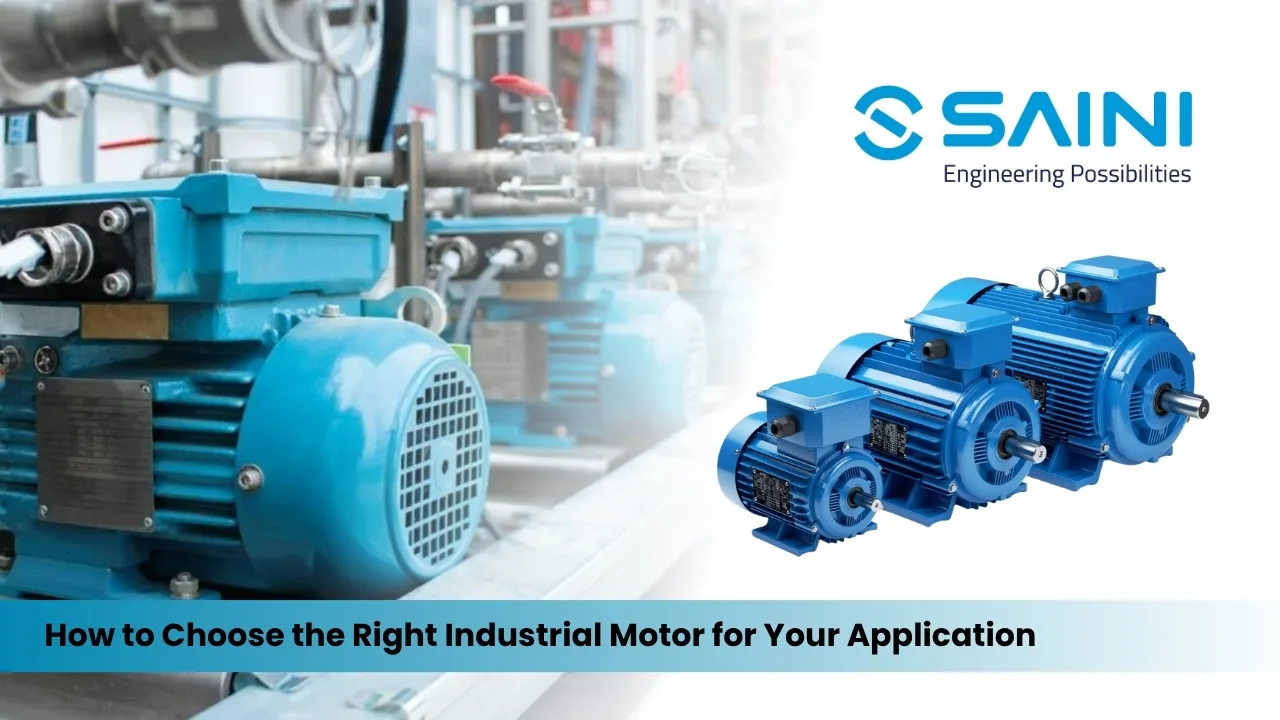
Industrial motors are essential components in manufacturing plants, processing facilities, transportation systems, and industrial machinery. Selecting the right motor directly affects equipment performance, energy efficiency, maintenance costs, and overall productivity. Choosing an unsuitable motor can result in frequent breakdowns, higher power consumption, and reduced operational efficiency.
Understand Your Application Requirements
Before selecting an industrial motor, identify the type of equipment it will power and the workload it must handle. Different applications such as pumps, compressors, conveyors, fans, and railway systems require different motor specifications. Understanding the operating environment, load conditions, and required performance is the first step toward making the right choice.
Choose the Right Motor Type
Industrial motors are available in several types, including AC motors, DC motors, servo motors, and traction motors. AC motors are widely used for continuous industrial operations due to their reliability and low maintenance requirements. DC motors are preferred for applications requiring variable speed and high starting torque, while servo motors are ideal for precision-controlled machinery and automation systems.
Consider Power and Speed Requirements
Motor power should match the application's workload. An undersized motor may overheat and fail prematurely, while an oversized motor can increase energy costs unnecessarily. It is also important to evaluate the required operating speed and determine whether fixed-speed or variable-speed operation is needed.
Focus on Energy Efficiency
Energy-efficient motors help reduce electricity consumption and lower operating costs over time. Since industrial motors often run for long hours, investing in high-efficiency motors can provide significant long-term savings while supporting sustainability goals.
Evaluate Operating Conditions
Environmental factors such as temperature, dust, moisture, and chemical exposure can affect motor performance. Choosing a motor designed for the specific operating environment helps improve reliability, reduce maintenance requirements, and extend equipment lifespan.
Importance of Maintenance
Regular maintenance plays a crucial role in ensuring motor performance and longevity. Preventive inspections, proper lubrication, and condition monitoring help identify potential issues before they become major failures, reducing downtime and repair costs.
Final Thoughts
Choosing the right industrial motor requires careful consideration of application requirements, motor type, power capacity, efficiency, and operating conditions. A properly selected motor improves productivity, reduces operational costs, and delivers reliable long-term performance.
Why Choose Saini Electrical Engineering Pvt. Ltd.?
Saini Electrical Engineering Pvt. Ltd. specializes in industrial motors, traction motors, alternators, generators, and electrical rotating equipment. With extensive industry experience and advanced engineering capabilities, Saini provides reliable motor solutions, repair services, and maintenance support to help industries achieve maximum efficiency and operational reliability.