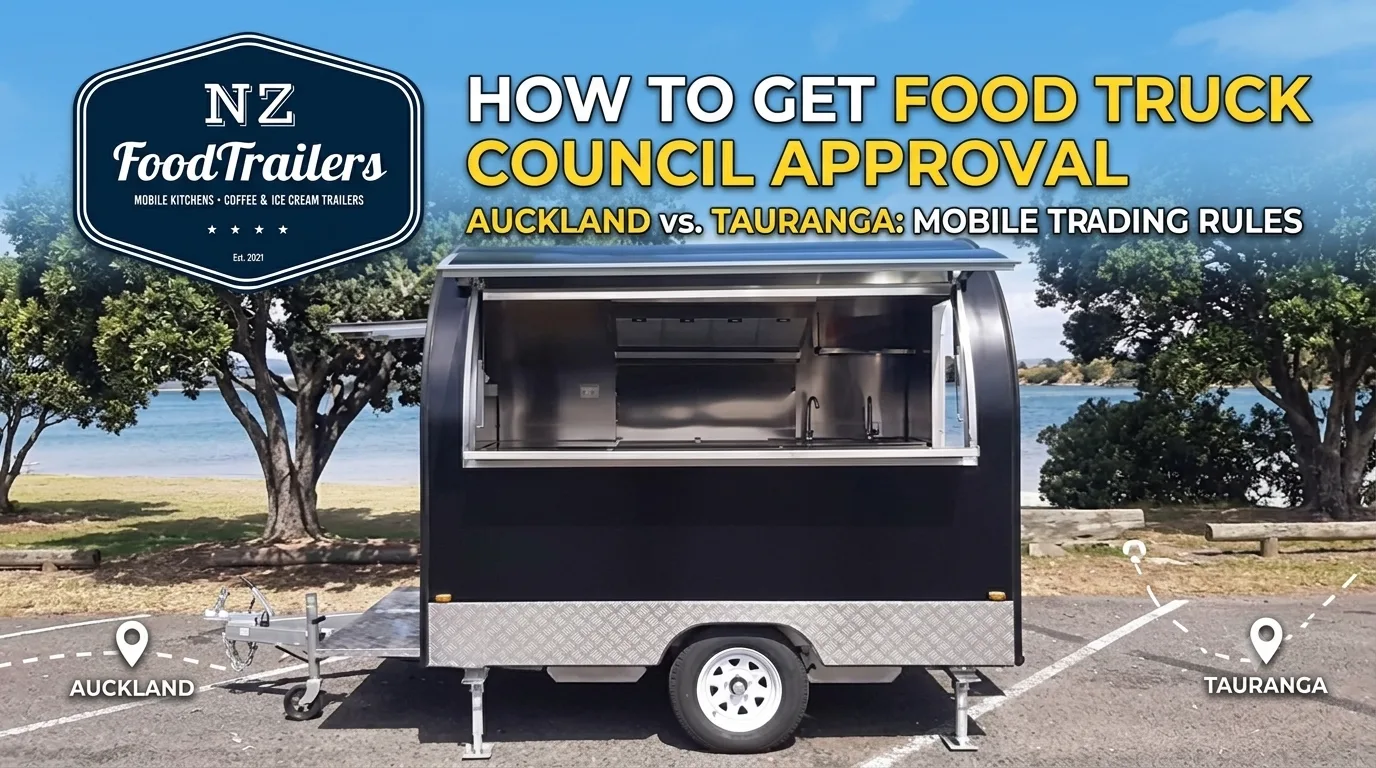
If you're searching for a coffee cart for sale in New Zealand and planning to trade in Auckland or Tauranga, you'll need two things sorted before your first service — a Food Act 2014 registration and a mobile trading licence from your local council. The rules differ between regions, the compliance requirements on your trailer are non-negotiable, and getting both right from day one is what separates operators who trade confidently from ones who get turned away at the gate. This guide breaks down exactly what applies to you, city by city.
Let's go through it properly.
The Foundation: Food Act 2014 and Registering Your Mobile Business
Before you apply for a single council parking permit, before you book a market stall, before you pull up at your first location — you need to be registered under the Food Act 2014. This applies everywhere in New Zealand, regardless of which city you're trading in. It's not optional and it's not something you sort out after you've started.
Most coffee carts and lighter food operations register under National Programme 1 (NP1) — this covers low-risk food businesses like espresso coffee, pre-packaged food, and simple cold food. If you're running a hot food trailer processing meat, poultry, or high-risk dairy-based products, you'll likely need a Template Food Control Plan (TFCP), which involves more documentation and a more involved registration process.
The registration happens through your local council. You submit your food safety plan, your trailer gets inspected to confirm it meets the physical requirements, and you're issued your registration number. That number is what you need to trade legally anywhere in New Zealand.
Once your Food Act registration is sorted, you move to the local council trading licence. And this is where Auckland and Tauranga start to look very different.
Trading in Auckland: Navigating the Mobile Trading Licence
Auckland is the biggest market in New Zealand and also the most regulated when it comes to mobile food trading on public land. If you're planning to trade anywhere on Auckland Council-managed public space — roads, footpaths, parks, reserves — you need an Auckland Council mobile trading licence before you show up.
Here's how the system works:
Fixed Site Licences allow you to register up to 5 fixed public locations on a single licence, provided your trading hours at those locations don't overlap.
Roaming Licences are designed for operators who move continuously rather than parking at fixed spots. This is the licence type used by ice cream vans and coffee carts doing suburbs or beach routes.
The rules you need to know for Auckland:
Your setup cannot block pedestrian sightlines or obstruct visibility at intersections. You must stay at least 50 metres away from intersections and roundabouts. Trading from a grass berm or footpath without specific written authorisation from Auckland Transport is not permitted. And if you're anywhere near a school, there are additional restrictions around trading hours.
Private property and event trading is a different situation — if you're at a market, a private event, or on land with landowner permission, the mobile trading licence isn't required for that location. Your Food Act registration and the event organiser's approval are what matter there.
The Auckland mobile trading licence application goes through Auckland Council's licensing team. Processing times vary, so factoring in 4–6 weeks for approval before your intended start date is sensible.
Trading in Tauranga: Mobile Shops and Tender Locations
Tauranga operates a different system to Auckland, and for operators based in the Bay of Plenty — or planning to trade here — it's worth understanding in detail.
The local equivalent is the Tauranga City Council mobile shop licence. The terminology is slightly different (TCC calls them mobile shops rather than mobile traders) but the principle is the same — you need authorization to trade on public land.
Here's what the Tauranga system looks like in practice:
The 15-Minute Rule applies to road reserve trading. If you're on a public road reserve — the area between the road and private property boundaries — you can trade without a fixed spot licence provided you move every 15 minutes and don't return to the same location twice in the same trading day. This is what makes the roaming coffee cart model work in suburban Tauranga.
Parks and Reserves (non-tendered) allow mobile traders to use formed car parks between sunrise and sunset on a first-come, first-served basis. You can occupy a maximum of 2 car parks at any one time.
Tendered Sites are the premium locations. Spots like Marine Parade and Mount Main Beach — the highest foot traffic locations in the region, particularly through summer — are managed through a competitive annual tender process run by Tauranga City Council every August. You apply, the board evaluates proposals, and successful applicants are granted exclusive trading rights for the season. These places are competitive and the process is taken seriously. If Mount Beach trading is part of your business plan, understanding the tender timeline and putting together a strong application is essential.
Private property and events in Tauranga work the same as Auckland — landowner or event organiser approval plus your Food Act registration is what you need. The council mobile shop licence is only required for public land trading.
Auckland vs. Tauranga: Quick Comparison Guide
RequirementAuckland Council RulesTauranga City Council RulesLicence TypeMobile Trading LicenceMobile Shop LicenceFixed Public LocationsUp to 5 spots per single licenceFormed reserve car parks, max 2 parksRoaming OptionYes — Roaming Licence availableYes — 15-minute move rule on road reservesHigh-Demand Beach ZonesRegulated by Street Trading InspectorAnnual competitive tender process (August)Private Property / MarketsNo licence needed — landowner approval + Food RegNo licence needed — event approval + Food RegSeparation from IntersectionsMinimum 50 metresCheck TCC conditions per locationFood Act RegistrationRequired — NP1 or TFCP depending on menuRequired — NP1 or TFCP depending on menuElectrical Certification4-year EWOF required4-year EWOF required
The Golden Rule: Get Your Trailer Compliance Right First
Here's the thing that trips up a lot of people who focus entirely on the licensing side without looking at the physical requirements of their trailer: no council in New Zealand will grant a mobile trading permit unless your build meets strict safety infrastructure standards.
Auckland and Tauranga inspectors — along with every other council in NZ — check for the following before approving a food trailer or coffee cart to trade on public land:
A valid 4-year Electrical Warrant of Fitness (EWOF) —Your trailer must be certified under AS/NZS 3001 standards by a registered electrical inspector. A standard home electrician's invoice is not enough; it must have an official blue EWOF sticker affixed to the body.
An LPG gas safety certificate — if your trailer runs gas appliances (which most cooking trailers and many coffee setups do), All gas lines, bottle storage boxes, and appliance ventilation must be signed off by a certified gasfitter registered with theGas Industry Company. This covers the installation, the connections, the ventilation around gas equipment, and the cylinder storage.
Install Split Fresh & Wastewater Separation —Your plumbing must feature separate hand-washing sinks (with hot water) and distinct food-prep sinks, connected to self-contained fresh water supply and grey-water containment tanks that meet local volume regulations.
Compliant fresh and wastewater holding tanks — your water system needs to hold sufficient fresh water for your trading session and contain wastewater without any discharge. Capacity requirements depend on your menu and trading volume.
Food-safe internal surfaces — bench tops, walls, and floors in the food preparation area need to be smooth, non-porous, and cleanable. This is assessed during your Food Act registration inspection.
Confirm On-Road WOF and Registration — The Final Road Legalities. Before the Council inspects the kitchen, the trailer frame itself must be completely road-legal with a current 3-year Warrant of Fitness (WOF) and active NZ transport registration.
All of this sounds like a lot — and retrofitting it into a trailer that wasn't built with it in mind genuinely is a lot. Which is why buying a trailer that's been built to these specifications from the start matters so much.
Frequently Asked Questions
Do I need a council licence to trade at a farmers market or food event in NZ?
No — if you're trading at a private event or market with landowner or organiser permission, you don't need a local council mobile trading licence for that specific location. Your Food Act 2014 registration is what's required. The council licence applies to trading on public land — roads, footpaths, parks, and reserves.
How long does it take to get a mobile trading licence in Auckland or Tauranga?
Processing times vary but factoring in 4–6 weeks is sensible for either council. Submitting a complete application with all required documentation speeds the process up. Incomplete applications get held up.
What's the difference between National Programme 1 and a Food Control Plan?
National Programme 1 (NP1) covers lower-risk food operations — espresso coffee, pre-packaged foods, simple cold food. A Template Food Control Plan (TFCP) is required for higher-risk food preparation involving raw meat, poultry, or complex cooking processes. Most coffee cart operators register under NP1. If you're unsure which applies to your menu, your local council's environmental health team can advise.
Can I trade from the same place every day in Tauranga without a tendered site?
On public road reserves, the 15-minute move rule means you can't stay in one spot — you need to move every 15 minutes and can't return to the same spot in the same day.
What is an Electrical Warrant of Fitness (EWOF) and do I really need one?
Yes — it's mandatory for mobile food trailers trading on public land in NZ. An EWOF certifies that your trailer's electrical installation meets AS/NZS 3001 standards, inspected and issued by a registered electrical inspector.
Can I apply for a Tauranga beach tender site as a first-time operator?
Yes — the tender process is open to all applicants. That said, the prime spots like Mount Main Beach are competitive. A strong application includes your food concept, your trailer setup, your food safety registration, and evidence of your ability to operate professionally. First-time operators who've already got their trailer compliance sorted and their Food Act registration in place are in a stronger position than those who haven't.
Do NZ Food Trailers build trailers that meet council compliance standards?
Yes — Every trailer built at the Mt Maunganui workshop is designed to meet NZ council requirements from the ground up. EWOF, LPG certification, compliant water systems, food-safe surfaces, WOF and road registration are all included. You're not retrofitting anything after delivery.
Conclusion
Choosing NZ Food Trailers means taking the stress out of mobile kitchen compliance. We engineer every chassis and fit-out to strict NZ regulatory standards using only qualified, certified installers. We ensure the plumbing layout, gas infrastructure, and electrical engineering are built correctly from day one—giving you a premium, turn-key asset designed to pass your local council inspections and hit the road with confidence.