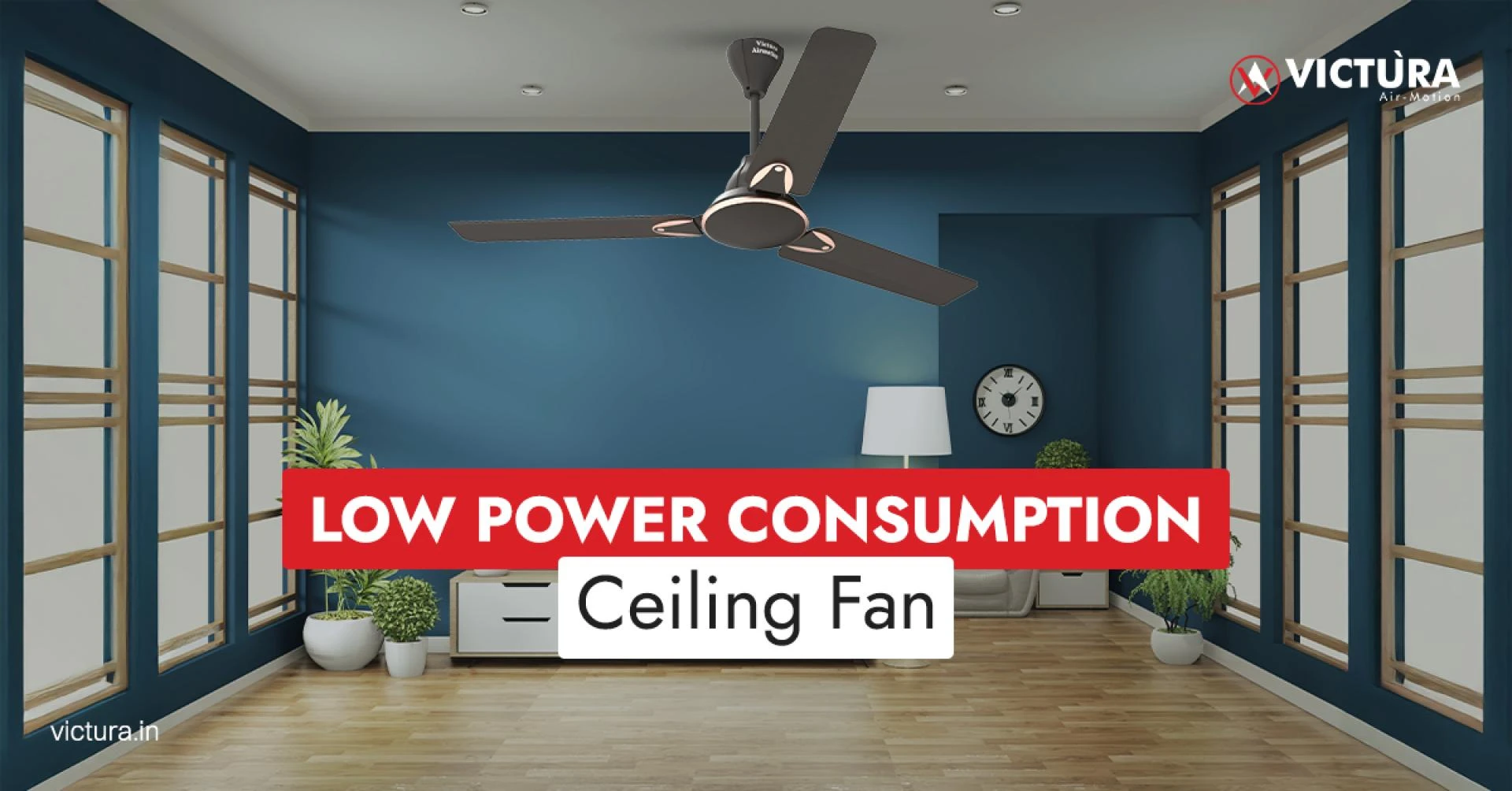
A Low Power Consumption Ceiling Fan that is also affordable is not as easy to find as you’d think. Yes, there’s many options in the market but do you know which is the right one to buy?
Energy efficiency is no longer a choice, but rather a requirement of modern life. Ironically, the same device that is meant to cool your home, your ceiling fan, can be either an energy saver or a silent energy consumer.
If you have the intention of cutting down your electric bill and at the same time leaving a smaller environmental footprint, then it is definitely a great idea to replace your old ceiling fan with one that has a low power consumption.
Let’s dive into the Low Power Consumption Ceiling Fan features that you need to look for!
Features You Need in a Low Power Consumption Ceiling Fan
So, what exactly features should you focus on? Here are the main attributes that turn a ceiling fan into an energy-efficient one:
1. The Powerhouse: BLDC Motor Technology
It is the one point that solely determines the extent of power consumption.
What it is
BLDC is a brushless direct current don’t you know. Besides AC (Alternating Current) induction motors, which are used in traditional fans, BLDC motors accomplish the rotation with permanent magnets and a rather complex electronic circuit.
Why is it necessary
BLDC fans are capable of consuming even 70% less power than their AC counterparts. Normally, a fan is consuming about 75-80 watts, whereas the best quality BLDC fan is hardly beyond 28-35 watts, even at the highest speed.
Such a big drop in the amount of electricity used goes almost entirely into the pockets of the consumer over time.
2. Smart Operation: Remote Control and Speed Settings
Efficiency is about the most proper usage of the motor, not just the motor itself.
Remote control
A remote lets you change the speed of the fan from any place in the room thus you are more prone to use the lowest, and therefore the most energy-efficient, speed setting at which you remain comfortable.
Exact Speed Control
Make sure the fan you are buying has several, you can say even very precise, different speed setting options (e.g., 5 or more speeds) instead of simply three.
This allows you to perfectly adjust the airflow to your comfort level and thus you will not be wasting energy by using the fan running at a higher speed than necessary.
3. Design Matters: Aerodynamically Optimized Blades
The motor is the one that powers the whole thing, but the blades are the ones that actually move the air.
Blade Material and Pitch
You should inspect the blades of a fan to be sure that they are made of a light material, are nicely shaped and are aerodynamically designed.
These contemporary models are specifically designed to achieve the maximum air delivery (Cubic Feet per Minute or CFM) at the same time they reduce the drag, thus allowing the fan to move more air with less power.
Less Noise, More Air
Efficient blades are often a reason a fan is quieter because the motor doesn't have to work as hard to push the air.
4. Added Intelligence: Specialized Features
Some of the modern fans have features that make them more efficient and also more convenient to use, such as:
Sleep/Timer Mode
A timer is extremely useful when you want to use the device overnight. You can program the fan to turn off by itself when you've already fallen asleep or to gradually lower its speed during the night (Sleep Mode) thus avoiding the fan from running at a constant high speed all night long.
LED Light Integration
In case the fan has a light kit, make sure the light is an integrated LED. This hardly adds any wattage as compared with old incandescent or CFL bulbs and thus the fan remains a low-power device.
Inverter Compatibility
Although it is not a feature that saves power, the fact that a fan is compatible with inverters or UPS (Uninterruptible Power Supply) means that it will be able to run without any difficulties or noise during power outages and it won't give off a buzzing sound or use a lot of power to get started.
Victura Airmotion: The Future of Energy-Efficient Cooling
Victura Airmotion is very much on low power consumption with its ceiling fans which are one of the leading devices of this movement; performance and sustainability being the two main factors that the company has focused on throughout.
This energy-saving measure at its most is to be found in the high-tech motor and the smart features of the device.
The BLDC Advantage
The primary power-saving technology is the most important implementation of the Brushless Direct Current (BLDC) motor in a large number of the Victura Airmotion models, such as Aethra and Renacer.
Ultra-Low Wattage
While 75-80 watts is the power consumption of a fan with a normal induction motor, Victura's BLDC fans vary a lot from that standard, as they can use as little as 32 watts on their highest speed for many models.
The power cut of over half means that you will save quite a lot of money on your electricity bill straight away.
Optimal Service Value
The fans operate on a high "Service Value" (CMM/Watt) level due to the fact that they are able to produce a very high volume of air flow (Cubic Metres per Minute or CMM) with very low electricity consumption.
This ensures maximum cooling output for every unit of power consumed.
Smart Modes for Smarter Savings
Besides the motor, Victura Airmotion also offers a range of smart features that ensure that power is used only when and how it is needed:
RF Remote Control
Making speed changes easily from the place where you are, thus also encouraging the use of the speed that is the most energy-saving and at the same time the most comfortable of all, which is why energy consumption is kept at a minimum.
Sleep Mode
Fan speed is decreased stage by stage during deep sleep time, thus energy is saved in that period and comfort is still provided.
Timer Function
The timer option is used to set the fan to turn off by itself after a given, pre-determined period of time, thus it is avoided that the fan running later during the whole night unintentionally.
Speed Settings
The provision of precise control to an extremely great extent is what makes these fans excellent energy-saving devices because the user can always find an appropriate setting for his or her cooling needs without unnecessarily wasting electricity.
Wide Voltage Operation
BLDC technology guarantees constant speed and power consumption during a voltage drop without the need for any additional power from the source; on the other hand, AC fans could consume more than their normal wattage during voltages under the rated ones.
With the addition of convenient, power-efficient control options to the BLDC motor's revolutionary efficiency, Victura Airmotion makes it possible for you to have powerful and silent airflow at the same time while still being low on energy and low on money.
Best Low Power Consumption Ceiling Fan Options For You
1. Victura Airmotion – Aerowind
- 225 RPM Motor Speed
- 38 W Power Consumption
- 1320 mm Fan Sweep Size
- 290 CMM Air Delivery
2. Victura Airmotion – Aeroflow
- 225 RPM Motor Speed
- 38 W Power Consumption
- 1200 mm Fan Sweep Size
- 250 CMM Air Delivery
3. Victura Airmotion – Ecowind+
- 350 RPM Motor Speed
- 30 W Power Consumption
- 1200 mm Fan Sweep Size
- 225 CMM Air Delivery
Conclusion
It is worth mentioning that the Low Power Consumption BLDC Ceiling Fan, in particular, is equipped with a BLDC motor, which may require you to spend a little more money at the first stage of the purchase.
But the money you save on your electricity bill every month will be your payback quite fast. It is not a simple fan that you are buying, but rather a more sustainable, cost-effective, and comfortable home environment.
Make a wise decision, go for Victura Airmotion BLDC!
Frequently Asked Questions (FAQs)
Q1. Which ceiling fan consumes less power?
The BLDC motor fan is a power-hungry user for sure but it uses less energy as compared to a conventional AC induction fan.
Q2. Are BLDC fans good or bad?
BLDC fans are good because they are highly energy-efficient (up to 65% less power), quiet, and durable, despite having a higher initial cost.
Q3. How much power does a 1200mm ceiling fan use?
Normally, a 1200mm fan will take up about 70-75 watts; a BLDC unit will only take up 28-35 watts.
Q4. How can I reduce ceiling fan power use?
The best measures to save power are to switch to a BLDC fan and always use the lowest speed that is comfortable for you.
Q5. How much electricity does a ceiling fan use in 24 hours cost?
A standard 75W fan costs about ₹10.80 per day (based on a ₹6/kWh rate); a 30W BLDC fan costs about ₹4.32 per day.
Q6. How do I choose a low-wattage fan?
Find out which fans come with a BLDC motor by the label and then confirm that the energy rating by BEE is 5-star.