
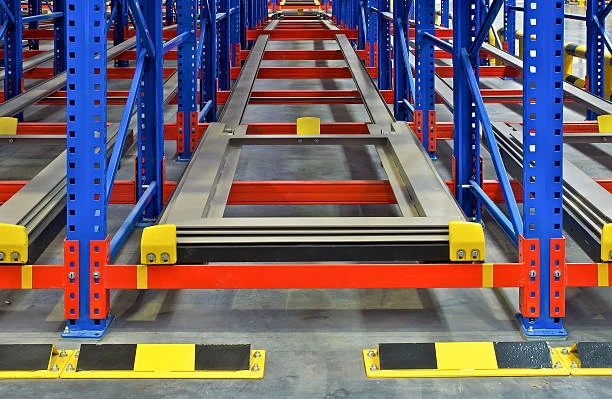
Shuttle Racking is one of the most efficient storage solutions for modern warehouses aiming to maximize space, improve speed, and reduce labor costs. By using a semi-automated shuttle system to move pallets within storage lanes, businesses can significantly increase storage density while minimizing forklift movement. In our experience working with high-volume warehouses, Shuttle Racking consistently improves operational flow, reduces errors, and enhances safety. For companies dealing with large inventories and repetitive SKU handling, it offers a smart balance between automation and cost-effectiveness—making it a practical upgrade from conventional systems.
What Is Shuttle Racking and How It Works?
Shuttle Racking is a high-density pallet storage system that uses a motorized shuttle to transport pallets inside racking lanes. Unlike traditional Warehouse Pallet Storage Racks, forklifts do not enter the storage lanes. Instead, they place pallets at the entrance, and the shuttle carries them to the correct position. We’ve seen this system perform exceptionally well in warehouses where speed and consistency are critical. The shuttle is controlled via a remote or integrated system, ensuring precise pallet placement. It supports both FIFO and LIFO inventory management, making it flexible for different operational needs. This system is especially valuable in environments where space is limited but storage demand is high, such as distribution centers and manufacturing facilities.
Why Shuttle Racking Improves Warehouse Efficiency?
Efficiency in warehousing is not just about storing more—it’s about moving goods faster and safer. Shuttle Racking achieves this by reducing unnecessary movement and automating repetitive tasks. One of the biggest improvements comes from reduced forklift travel. Since forklifts no longer need to enter deep lanes, operations become faster and less dependent on operator skill.
Here’s what makes Shuttle Racking highly efficient:
- Increased storage capacity within the same footprint
- Faster loading and unloading cycles
- Reduced labor dependency and operational costs
- Lower risk of product and rack damage
- Improved inventory accuracy and tracking
We’ve seen businesses improve throughput significantly after implementation, especially during peak demand periods.
Shuttle Racking vs Traditional Storage Systems
Many warehouses still rely on systems like Drive-in Rack, which offer high density but come with operational limitations. While Drive-in Rack systems require forklifts to enter storage lanes, Shuttle Racking eliminates this need. From our hands-on experience, the difference is immediately noticeable. Shuttle systems reduce congestion, improve safety, and deliver consistent performance regardless of workforce variability.
Another key advantage is durability. Since forklifts stay outside the racking structure, there is less physical impact on the racks, leading to lower maintenance costs over time. Compared to standard Warehouse Pallet Storage Racks, Shuttle Racking provides a much higher level of space utilization, making it ideal for growing businesses.
Key Components of an Effective Shuttle Racking System
A successful Shuttle Racking setup depends on more than just the shuttle unit. Each component plays a crucial role in ensuring smooth operations.
Based on our implementation experience, the following elements are essential:
- Strong racking framework designed for heavy loads
- Intelligent shuttle carts with long battery life
- Rail systems for precise pallet movement
- User-friendly control systems
- Wire Mesh Decking for added safety and airflow
Wire Mesh Decking is particularly important in enhancing safety and maintaining pallet stability. We’ve found it especially useful in temperature-controlled environments where airflow is critical.
Best Applications for Shuttle Racking
Shuttle Racking is not a one-size-fits-all solution, but it excels in specific use cases. In our experience, it works best in warehouses that handle large volumes of similar products.
Industries that benefit the most include:
- Food and beverage storage
- Cold storage and freezer warehouses
- Pharmaceutical distribution
- FMCG and retail logistics
- Manufacturing and bulk storage facilities
We’ve seen companies in these sectors achieve remarkable improvements in both storage capacity and operational efficiency after adopting Shuttle Racking.
Long-Term Benefits and Return on Investment
Shuttle Racking is not just a storage system—it’s a long-term investment in operational efficiency. While the initial setup cost may be higher than traditional systems, the returns are substantial.
In our experience, businesses recover their investment through:
- Reduced labor costs over time
- Increased storage capacity without expansion
- Faster order processing and delivery
- Lower maintenance and repair expenses
One of the most valuable benefits is scalability. As your business grows, the system can be expanded without disrupting existing operations.
Conclusion
Shuttle Racking is transforming how modern warehouses operate by combining efficiency, safety, and scalability. It bridges the gap between traditional storage and full automation, offering a practical solution for businesses aiming to grow without increasing space. The key to success lies in choosing the right system design and implementation partner. Suhong Storage Rack focuses on delivering tailored solutions that align with real operational challenges—helping businesses build smarter, more efficient storage systems for the future.
FAQs
What is Shuttle Racking used for?
Shuttle Racking is used for high-density pallet storage in warehouses that need fast, efficient handling of large inventory volumes.
How does Shuttle Racking improve efficiency?
It reduces forklift movement, automates pallet handling, and speeds up loading and unloading processes.
Is Shuttle Racking better than Drive-in Rack?
Yes, in most cases. It offers better safety, faster operations, and less dependency on manual labor compared to Drive-in Rack systems.
Can Shuttle Racking be integrated with other systems?
Yes, it can be combined with Warehouse Pallet Storage Racks for a hybrid storage solution.
Is it suitable for cold storage?
Absolutely. Shuttle Racking performs exceptionally well in cold storage environments due to reduced human exposure and efficient space usage.