A fiber network may seem like a continuous length of cable running between buildings, cabinets, and equipment rooms. Underground, however, the route is rarely that simple. Cables change direction, branch toward customers, pass through crowded utility corridors, and sometimes need repair. The less visible part of network design is making those locations accessible without repeatedly excavating the ground.
Underground fiber networks need accessible points where technicians can manage cables, inspect connections, and carry out maintenance. A fiber optic handhole provides this access without requiring crews to excavate long sections of the network.
More Than a Box Beneath the Ground
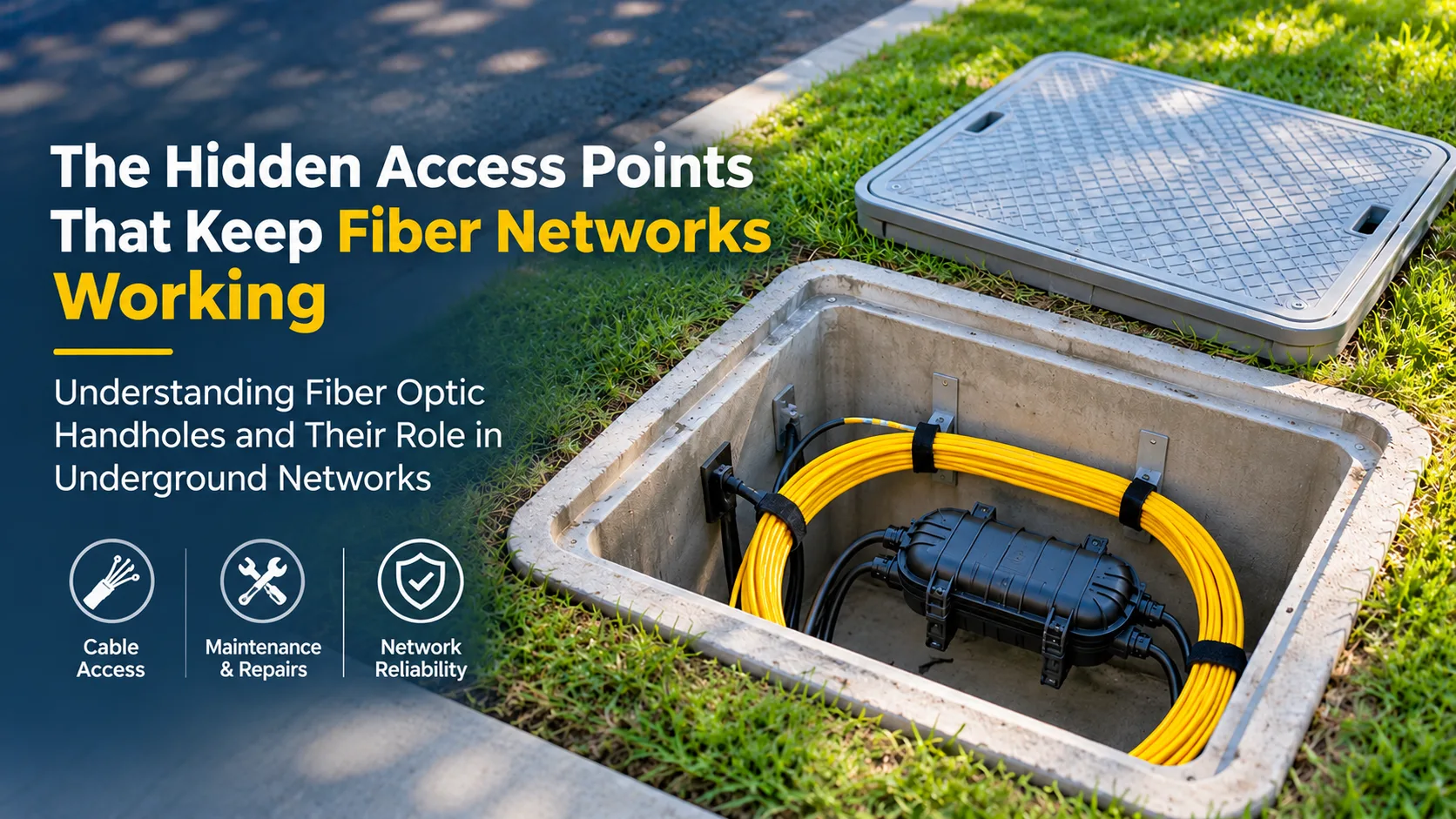
A handhole is a below-ground enclosure with an accessible cover at the surface. Technicians normally work from above rather than entering it. Depending on the network design, it may serve as a cable pulling point, a location for storing spare cable, or a place to access a protected splice closure.
These functions are related but not identical. A pulling point helps crews manage cable placement through ducts. A slack-storage location holds extra cable that may be needed for future work. A splice location gives technicians access to connections between cable sections. Not every handhole needs to perform all three functions.
This distinction matters because an enclosure adequate for a simple cable pass-through may be too small for a splice closure and its associated cable loops.
Why Access Points Influence the Entire Route
Underground fiber cables commonly travel through ducts or innerducts. Pulling a cable along a long pathway creates tension, especially where the route contains several bends. Access points can divide a complicated route into more manageable sections.
Their position should follow the actual pathway, not an arbitrary spacing rule. A straight run, a tight corner, an intersection with another route, and a planned branch each introduce different considerations.
Access also affects repair work. If a cable is damaged between two known points, technicians benefit from having practical locations where the cable can be examined or replaced. An enclosure positioned where vehicles regularly park, water collects, or landscaping blocks the cover might be technically present but difficult to use.
Good route planning therefore asks two questions: Where will access be needed during construction, and where will it be needed years later?
Size Is About Workable Space, Not Just Dimensions
Enclosures are often described by their length, width, and depth, but the internal arrangement is just as important. A handhole may contain multiple ducts, cable loops, a splice closure, and mounting hardware. All of these compete for space.
Fiber cable also has a minimum bend radius specified by its manufacturer. Forcing loops into a small enclosure can place unwanted stress on the cable. Technicians need enough room to organize slack without sharp bends, crossed cables, or pressure against the lid.
The opening must be practical, too. A large enclosure with a narrow or awkward cover may make it difficult to remove a closure for inspection. When planning for future expansion, usable space for additional cables can be more valuable than simply choosing the smallest box that fits the initial route.
The Surface Above Determines the Strength Below
A fiber optic handhole placed in a landscaped pedestrian area faces different demands from one near a parking lot or service drive. Covers and enclosure walls must be selected for the loads they are expected to encounter.
In the United States, underground enclosure specifications often reference ANSI/SCTE 77 load-rating tiers. Ratings such as Tier 15 and Tier 22 are associated with defined test conditions. They should not be treated as blanket approval for locations exposed to regular, deliberate vehicle traffic. The complete enclosure, cover, installation conditions, and project requirements all matter.
Construction materials also vary. Polymer concrete, reinforced concrete, and other engineered materials offer different combinations of weight, handling characteristics, and structural performance. Rather than selecting by material name alone, designers consider the environment, expected loading, access needs, and applicable specifications.
Water Management Deserves Attention
Underground access points are exposed to soil moisture, runoff, and changing groundwater conditions. Even a sturdy cover does not automatically make the space watertight.
This is why cable splices are typically protected within suitable sealed closures rather than relying on the surrounding handhole to stay dry. Poor site drainage can leave a chamber filled with sediment or standing water, making inspections harder and increasing the risk of damage to improperly protected components.
Local ground conditions matter. Soil movement can affect the enclosure and nearby ducts, while a low-lying location may be prone to repeated flooding. Drainage details, bedding, backfill, and utility-owner requirements should be evaluated as part of the broader civil design.
Slack Cable Is a Maintenance Resource
Spare cable stored inside a handhole may look like unused material, but it serves a practical purpose. A technician might need to bring a splice closure above ground, replace a damaged section, or rearrange a connection during a future network change.
Without adequate slack, a repair can require more disruptive work to reach usable cable. Too much poorly organized slack, on the other hand, can crowd the enclosure and complicate maintenance.
The appropriate amount depends on the cable design, the purpose of the access point, and the network owner's specifications. Slack should be arranged and secured so that it remains identifiable, accessible, and within the cable's allowable bend limits.
Documentation Is Part of the Infrastructure
A well-designed underground access point becomes less useful if future maintenance teams cannot locate it or understand what is inside.
Accurate records should identify the enclosure location, connected duct routes, cable identifiers, splice details where applicable, and any reserved pathways. As-built drawings are particularly valuable when field conditions differ from the original design.
Clear labels help teams distinguish cables during repairs and reduce the chance of disturbing unrelated services. Records also make future network expansions easier: planners can determine whether an existing access point has sufficient capacity before proposing new excavation.
A Simple Principle for Better Long-Term Networks
The most useful question is not whether an enclosure will fit beneath the surface today. It is whether someone will be able to work safely and efficiently at that location five or ten years from now.
A suitable fiber optic handhole supports cable access, manageable routing, protected connections, and future maintenance. Thoughtful decisions about placement, internal space, loading, water exposure, and documentation turn a small underground structure into a valuable part of the network's long-term reliability.