
In today's digital age, integrating artificial intelligence (AI) into business processes is more crucial than ever. Among the transformative elements of AI, the concept of an AI Agent stands out, offering solutions that enhance the operational framework of enterprises. Understanding "What is an AI Agent" and how it integrates into broader Enterprise AI strategies provides enterprises with intelligent systems that drive efficiency and innovation across different sectors.
Defining AI Agents in the Context of Enterprise AI
An AI Agent is software that acts autonomously to perform tasks, learn from its environment, and make informed decisions to meet specific objectives. Working within predefined parameters, it mimics human cognitive abilities, facilitating processes across various business operations. As enterprises seek to optimize and innovate, AI Agents serve as the linchpin, automating manual tasks and offering predictive insights.
Key Capabilities of AI Agents
- Autonomous Operations: They perform tasks without continuous human supervision, freeing employees from repetitive work.
- Adaptive Learning: Using machine learning algorithms, they continually improve their efficiency and accuracy with new data and experiences.
- Proactive Decision-Making: They not only react to current scenarios but also predict future trends to support strategic planning and risk assessment.
These capabilities underline the importance of AI Agents in driving productivity and enhancing decision-making within modern enterprises.
Enhancing Enterprise Efficiency with AI Agents
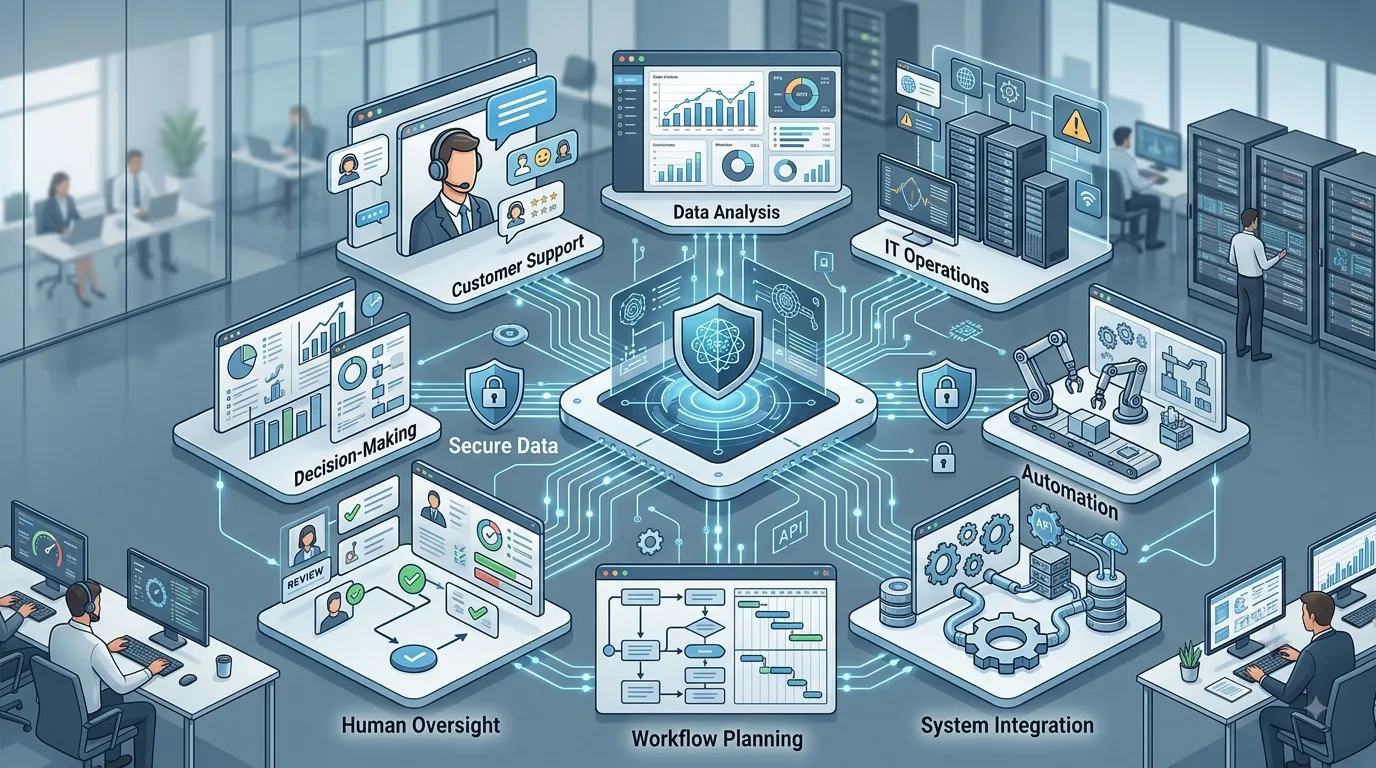
AI Agents are used across industries to streamline processes and boost operational efficiency. Their ability to interpret extensive datasets swiftly and accurately positions them as essential components of an Enterprise AI Platform.
Applications of AI Agents in Different Sectors
- Customer Service Automation: They manage customer queries via chatbots, providing 24/7 support and enhancing the customer experience.
- Data Analytics and Forecasting: AI Agents process large data sets to generate predictive insights for inventory management and strategic planning.
- Manufacturing and Production: They optimize production schedules and quality control, reducing downtime and improving output quality.
These applications demonstrate the versatility of AI Agents in enhancing enterprise operations and maintaining a competitive edge.
Understanding What Is an AI Agent
A deeper understanding of what an AI Agent is reveals its proactive, resourceful, and adaptive nature—essential qualities for executing complex tasks with precision and efficiency.
Characteristics of AI Agents
- Environmental Responsiveness: They perceive and adapt to changes in their operating environment in real-time.
- Logical Reasoning: Using advanced algorithms, they solve complex problems effectively, aiding decision-making.
- Continuous Evolution: AI Agents learn from new data inputs to stay relevant and efficient over time.
Recognizing these characteristics is critical for enterprises deploying AI Agents to transition toward more intelligent and responsive business processes.
Future Trends and Strategic Implementation
AI Agents are at the forefront of the digital transformation revolution. As technology advances, they are expected to take on even more significant roles within enterprise operations.
Emerging Trends Involving AI Agents
- Increased Focus on Hyperautomation: AI Agents will be key to automating end-to-end business processes for enhanced efficiency and agility.
- Collaborative Intelligence Models: They will increasingly work alongside human teams, complementing human intuition with data-driven insights.
- Data-Driven Personalization: AI Agents will enable highly personalized customer experiences by analyzing vast datasets and tailoring interactions.
These trends highlight the strategic importance of integrating AI Agents into an Enterprise AI Platform to address both current and future technological demands.
A Future Ready with AI Agents
As businesses navigate digital transformation, integrating AI Agents offers a powerful strategic advantage. Enterprises must fully understand and harness the capabilities of AI Agents to enhance productivity, innovate services, and improve customer engagement.
The strategic deployment of AI Agents as part of a comprehensive Enterprise AI strategy promises to unlock new opportunities and drive enterprises forward into a future defined by intelligent technology.
FAQs
1. What is an AI Agent?
An AI Agent is an autonomous software entity that performs tasks, learns from its environment, and makes decisions to achieve operational objectives.
2. How do AI Agents integrate with Enterprise AI Platforms?
They function within Enterprise AI Platforms, providing automation, data analytics, and decision-making support across various business functions.
3. What industries benefit most from AI Agents?
Industries like finance, retail, healthcare, and manufacturing use AI Agents for improved efficiency, customer service, and strategic planning.
4. How do AI Agents enhance customer service?
By automating customer interactions and providing personalized, round-the-clock support.
5. What are the future trends involving AI Agents?
Trends include hyperautomation, collaborative intelligence models, and data-driven personalization.
6. Can AI Agents predict future business trends?
Yes, they use predictive analytics to anticipate trends and support strategic decisions.
7. Is data security a concern with AI Agents?
Yes, but robust Enterprise AI frameworks ensure strong data protection and regulatory compliance.
8. How does AI improve operational workflows?
AI Agents automate repetitive tasks, enhance accuracy, and reduce human error.
9. Will AI Agents replace human jobs?
AI Agents are designed to augment human capabilities, allowing workers to focus on strategic tasks.
10. How can businesses get started with AI Agents?
Identify areas for improvement, then implement AI Agents through a comprehensive Enterprise AI Platform.